

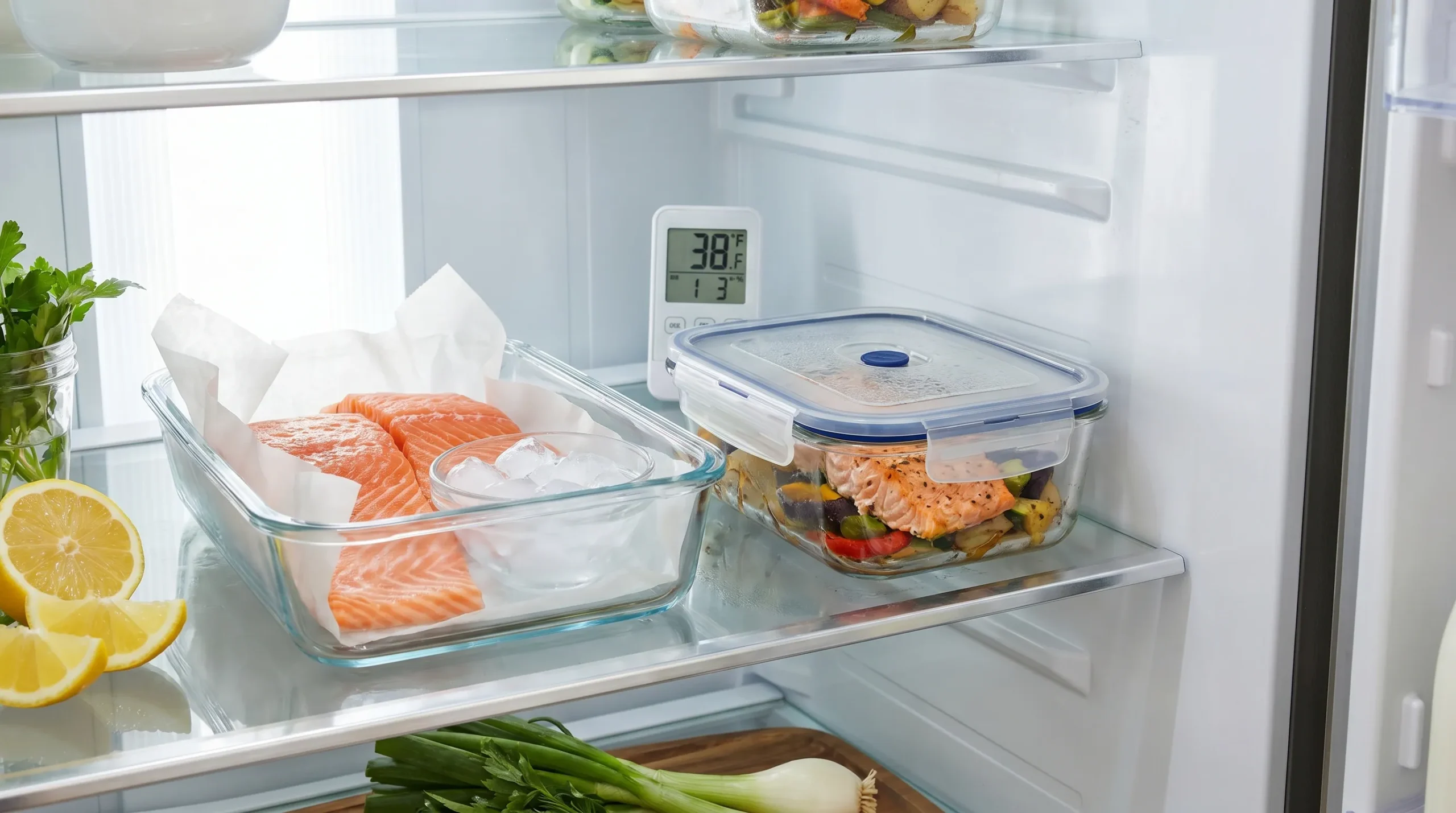
How long can salmon stay in the fridge is one of those questions where a simple answer matters, because with seafood, food safety comes first. In most cases, raw salmon keeps for 1 to 2 days, while cooked salmon usually keeps for 3 to 4 days, as long as your refrigerator is at 40°F (4°C) or below. The FDA also says seafood that will be used within 2 days can stay refrigerated, and otherwise it should be wrapped tightly and frozen.
That is the short answer, but real life is messier. Maybe your fresh salmon was bought yesterday and still smells fine. Maybe your cooked salmon leftovers sat out during dinner. Maybe you are wondering whether thawed salmon, smoked salmon, or vacuum-sealed salmon follows the same rules. This guide breaks all of that down in plain English, so you know what is still safe to eat, what needs to go in the freezer, and when it is time to throw it out.
Quick answer: salmon fridge life at a glance
Before we dig into details, here is the practical rule most readers want:
| Type of salmon | How long it lasts in the fridge | Best condition |
| Raw salmon | 1–2 days | 40°F (4°C) or below |
| Fatty fish like salmon | 1–3 days | Cold storage chart guidance |
| Cooked salmon | 3–4 days | Refrigerated promptly after cooking |
| Thawed salmon | Usually 1–2 days | Thawed safely in the refrigerator |
| Smoked salmon | Varies by package and whether opened | Follow package directions and keep cold |
The reason you see both 1–2 days and 1–3 days online is that different government charts frame it a little differently. The FDA’s general seafood guidance says refrigerate seafood only if you will use it within 2 days, while FoodSafety.gov’s cold storage chart lists fatty fish such as salmon at 1 to 3 days in the fridge. That is why the safest article advice is to treat 1–2 days as the best target for raw salmon, especially in home kitchens where temperatures are not always perfectly stable.
How long does raw salmon last in the fridge?
If you are asking how long does raw salmon last in the fridge, the safest answer is 1 to 2 days. That applies whether you bought a fillet, portions, or a larger cut of fresh salmon, as long as it has been kept properly chilled at 40 degrees F or below. The FDA specifically recommends storing seafood in a clean refrigerator at 40°F or below and using it within 2 days; if not, it should be frozen.
FoodSafety.gov adds a useful detail here. Its cold storage chart classifies salmon among fatty fish and gives a refrigerator storage window of 1 to 3 days. In practical terms, that means the fish may still be acceptable on day 2 or even day 3 in some cases, but the safest plan for home cooks is still to cook or freeze it sooner rather than later.
A good rule is this: if you bought raw salmon today and plan to cook it tomorrow, refrigeration is fine. If plans change and you will not use it within 1–2 days, move it to the freezer. That one habit does more for salmon freshness than almost anything else.
How you store it matters too. Keep the fish in its original packaging if that packaging is intact and cold, or transfer it to an airtight container or tightly wrap it in plastic wrap or foil. The coldest part of the fridge is usually better than the door, and many cooks place seafood on the bottom shelf of the fridge so it stays cold and does not drip onto other foods. The FDA also recommends tight wrapping with plastic, foil, or moisture-proof paper if you are moving it into freezer storage.
How long does cooked salmon last in the fridge?
For cooked salmon, the safe refrigerator window is usually 3 to 4 days. That is the standard food-safety advice for cooked fish and leftovers, and it gives you a little more flexibility than raw seafood.
This is where meal prep and batch-prepped salmon often trip people up. The fish may still look fine after several days, but appearance is not the whole story. The FDA notes that food can make you sick even when it does not obviously look spoiled, because harmful bacteria are not the same as the spoilage bacteria that create strong odors or visible changes.
So if you made baked salmon for dinner on Monday night and refrigerated the leftovers promptly, it is usually best to eat them by Thursday. If that cooked salmon sat out on the counter for too long before being chilled, the safe storage clock changes. The FDA says perishable foods, including seafood, should never sit out for more than 2 hours, or more than 1 hour when the temperature is above 90°F.
When reheating, many home cooks aim for 165°F (74°C) for leftovers as a cautious benchmark. Even though the FDA’s seafood cooking guidance says most seafood is cooked to 145°F, reheating leftovers thoroughly until steaming hot is the safer everyday approach.
Does thawed or defrosted salmon have a different fridge life?
Yes, thawed salmon does need a little extra attention. If you thawed frozen salmon in the refrigerator, you usually still have about 1 to 2 days to cook it. That is because once the fish is fully thawed, it behaves much like fresh raw seafood in terms of shelf life.
The safest thawing method is overnight in the refrigerator. The FDA also says you can thaw seafood more quickly by sealing it in a plastic bag and immersing it in cold water, or by using the microwave defrost setting if the fish will be cooked immediately after thawing.
That last part matters. If you used the cold water method or microwave method, do not put the fish back in the fridge for days and assume it is fine. Quick-thawed seafood should generally be cooked right away. Refrigerator-thawed fish gives you a little more flexibility, but even then, 1–2 days after thawing is the range to keep in mind.
How long does smoked or vacuum-sealed salmon last?
This is where many readers get confused, because smoked salmon and vacuum-sealed salmon are not always handled the same way as plain fresh fillets.
If the salmon is vacuum-sealed and still unopened, shelf life may be longer than ordinary fresh fish, but the exact time depends on whether the product is fresh, frozen, cured, or smoked and on the manufacturer’s package instructions. Once opened, the safe window shrinks fast, and refrigeration still matters. That is why checking the label is important here. The FDA specifically advises checking storage directions on labels because some foods outside the usual meat-and-dairy categories still need strict refrigeration.
Refrigerated smoked seafood deserves special caution. The FDA says refrigerated smoked seafood products such as salmon, trout, and whitefish are not recommended for certain at-risk groups unless used in a cooked recipe. That warning is especially relevant for pregnant women, older adults, young children, and people with weakened immune systems.
So, if you are wondering how long does smoked salmon last in the fridge or how long does vacuum-sealed salmon last in the fridge, the safest approach is to combine common-sense storage with the label’s instructions. Unopened packages may last longer than opened ones, but once you break the seal, think in much shorter terms and keep the product cold the entire time.
How to tell if salmon has gone bad
This is one of the biggest user pain points, because people do not want to waste food, but they also do not want to get sick.
The FDA’s freshness signs are very practical. Fresh fish should smell fresh and mild, not fishy, sour, or ammonia-like. Fresh fillets should have firm flesh, and they should not show discoloration, darkening, or drying around the edges. The FDA also warns that sour, rancid, or strongly fishy odors are red flags in raw or cooked seafood.
In everyday kitchen terms, here are the most common signs that salmon has gone bad:
- a strong, sour, or ammonia smell
- a slimy surface rather than a clean, moist one
- dull color or obvious discoloration
- mushy texture instead of firm flesh
- dried-out edges or an odd sticky film
Still, there is an important catch. Food-safety agencies caution that dangerous food is not always obvious. A piece of salmon can become unsafe even before it develops dramatic signs of spoilage. That is why time and temperature matter just as much as smell and texture.
A simple real-world example helps here. Imagine you bought salmon fillets on Saturday, kept them properly refrigerated, and on Monday they still smell mild and look good. Cooking them that day is usually reasonable. But if those same fillets spent part of the afternoon warm in the car, or your refrigerator was running above 40°F, the risk changes quickly. In those situations, being cautious is smart.
The best way to store salmon in the fridge
If your goal is how to keep salmon fresh, storage technique matters almost as much as the clock.
First, get the fish cold fast. The FDA says seafood should go on ice or into the refrigerator or freezer soon after buying it. If you will use it within 2 days, refrigerate it at 40°F or below. Otherwise, freeze it.
Second, protect it from air and cross-contamination. Keep raw salmon tightly wrapped or in an airtight container. If the fish is not staying in its original packaging, use plastic wrap, foil, or a covered container. Keep it away from ready-to-eat foods so raw seafood juices do not spread bacterial growth to other items. The FDA specifically recommends washing hands, utensils, dishes, and cutting boards carefully after handling raw seafood.
Third, trust a thermometer, not a guess. The FDA says the refrigerator should stay at or below 40°F (4°C), the freezer at 0°F (-18°C), and appliance thermometers are the best way to know the actual temperature. That is a major detail many articles skip, but it is one of the best food safety upgrades you can make at home.
Can you freeze salmon, and how long does it keep?
Yes, you can absolutely freeze salmon, and if you know you will not eat it within 1–2 days, freezing is the smart move.
The FDA says properly frozen food stored at 0°F (-18°C) remains safe indefinitely, although quality declines over time. That means your salmon may still be safe later on, but flavor, texture, color, and juiciness will gradually suffer. Freezer burn is also a quality problem, not a safety one. It usually happens when food is not wrapped tightly enough.
FoodSafety.gov’s cold storage chart lists fatty fish such as salmon at about 2 to 3 months in the freezer for best quality. That is a useful target if you want the fish to taste its best later.
So the practical answer is this: yes, salmon can stay in the freezer much longer, but for quality, try to use it within a few months. Wrap it tightly, remove as much air as possible, and label it with the date. That makes it easier to avoid forgotten packages buried in the back of the freezer.
Can you refreeze thawed salmon?
Sometimes, yes. If the salmon was thawed safely and kept cold, it may be refrozen, although quality may suffer.
The FDA’s guidance during power outages is a helpful analogy here: food may be safely refrozen if it still contains ice crystals or is at 40°F (4°C) or below, but the quality can drop.
In everyday use, that means salmon thawed in the refrigerator is much more likely to be okay to refreeze than salmon thawed quickly in warm conditions. If you used the microwave or cold water method, it is better to cook the fish immediately rather than send it back to the freezer raw.
How long can salmon sit out before it becomes unsafe?
This is one of the most useful sections to add because many competing articles barely address it.
The FDA says never leave seafood or other perishable food out of the refrigerator for more than 2 hours, or more than 1 hour if the temperature is above 90°F. Harmful bacteria grow quickly in the danger zone between 40°F and 140°F.
So if raw salmon sat on the counter all afternoon, it should be discarded. If cooked salmon leftovers were left out after dinner for more than two hours, they should also be thrown away. This is not the place to rely on smell or appearance. Once seafood has spent too long warm, the safest answer is to let it go.
What happens if the fridge loses power?
This is one of the clearest content gaps competitors miss, and it is genuinely useful.
FoodSafety.gov says your refrigerator will keep food safe for up to 4 hours during a power outage if the door stays closed. After 4 hours without power, refrigerated perishable foods such as fish, meat, eggs, and leftovers should be discarded. The chart also says seafood exposed to 40°F (4°C) or above for more than 2 hours should be thrown out.
The FDA gives the same basic message: if the power was out more than about four hours, refrigerated perishable food should not be kept.
That means if you are wondering about salmon after power outage, the answer depends less on how old it was and more on how warm it got and how long the fridge was without power.
What fridge and freezer temperatures are actually safe for salmon?
This is where precision helps.
The FDA recommends keeping the refrigerator temperature at or below 40°F (4°C) and the freezer temperature at 0°F (-18°C). It also says appliance thermometers are the best way to check those temperatures and that they should be monitored regularly.
That matters because many home refrigerators drift warmer than people realize. If your fridge runs at 45°F, the safe storage window for seafood gets much riskier. If your freezer is warmer than 0°F, the fish may still freeze, but quality drops faster and you have less confidence in long-term storage.
In other words, the safest salmon-storage setup is not just “put it in the fridge.” It is keep the fridge at 40°F or below, keep the freezer at 0°F, and use a thermometer so you know those numbers are real.
Frequently asked questions about salmon storage
Can I eat salmon after 3 days in the fridge?
If it is raw salmon, day 3 is already pushing past the FDA’s basic within 2 days recommendation, even though the cold storage chart for fatty fish allows 1–3 days. If it is cooked salmon, 3 days is usually still within the normal 3–4 day window if it was refrigerated promptly.
Is salmon still good after 4 days?
For raw salmon, that is usually too long. For cooked salmon, day 4 may still be acceptable if it has been handled correctly, but this is the end of the usual safe window.
Can I refrigerate salmon in its original packaging?
Yes, if the packaging is intact and the fish stays cold. Otherwise, transfer it to a tightly sealed wrap or container.
Should I wash salmon before storing it?
No. Washing raw fish can spread contamination around the sink and kitchen. Safe handling matters more than rinsing. The FDA emphasizes preventing cross-contamination through proper handwashing and cleaning surfaces after handling raw seafood.
Can I eat cooked salmon cold from the fridge?
Yes, many people do, as long as it was stored safely and is still within the normal 3–4 day window. If you reheat it, heat it thoroughly.
Final takeaway: when to keep salmon and when to throw it out
The safest way to think about salmon shelf life is simple. Raw salmon should usually be cooked or frozen within 1–2 days. Cooked salmon is usually good for 3–4 days. Your refrigerator should stay at 40°F (4°C) or below, and if seafood sits out more than 2 hours, it is no longer worth the risk.
If you are ever unsure, use this rule: trust time and temperature more than guesswork. A piece of salmon that looks fine can still be unsafe if it stayed too warm, too long. And if your plans change, the freezer is your friend. That one move can save both your dinner and your peace of mind.
Disclaimer: This content is for general informational purposes only and should not be considered professional food safety, medical, or dietary advice. Always follow official food safety guidelines from trusted authorities such as the FDA or local health departments. When handling or consuming seafood like salmon, use proper storage practices and your best judgment. If you are unsure about the safety of any food, it is best to discard it or consult a qualified food safety professional.