

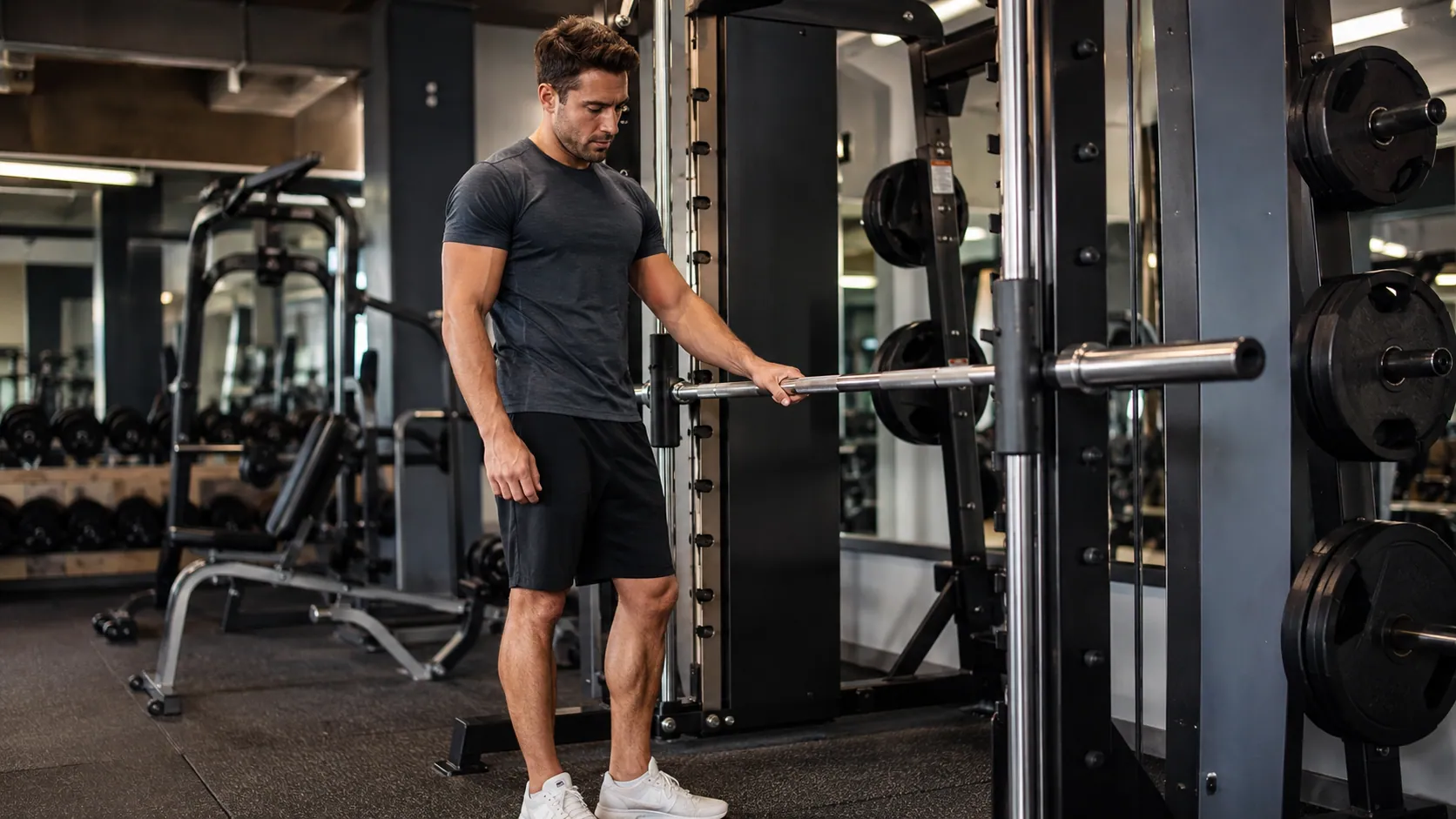
How much is the bar on a Smith machine is one of the most common questions beginners ask when they start tracking gym workouts, and the honest answer is: it depends on the machine. Most Smith machine bars commonly feel like 15–25 pounds, but the real range can be anywhere from about 5 to 45 lb depending on the machine type, brand, counterbalance system, and rail design.
That is why two people can use different Smith machines and get completely different answers. One machine at a commercial gym may have a very light counterbalanced Smith machine bar, while another home gym or older commercial model may feel closer to a regular 45 lb Olympic barbell.
The most useful number is not always the physical bar weight. It is the starting resistance, also called the takeoff load, felt resistance, or real working load. This is the weight you should use when calculating your total lift.
How Much Does a Smith Machine Bar Weigh?
A Smith machine bar usually weighs or feels like 15–25 pounds, but Smith machine bar weight is not standardized. Some machines start as low as 5–15 lb, while heavier or non-counterbalanced machines may feel closer to 30–45 lb.
Here is a simple guide:
| Smith Machine Type | Common Bar / Starting Resistance |
| Light counterbalanced commercial Smith machine | 5–15 lb |
| Standard commercial Smith machine | 15–25 lb |
| Home gym Smith machine | 15–35 lb |
| Non-counterbalanced Smith machine | 30–45 lb |
| Standard Olympic barbell | 45 lb / 20 kg |
This means you should not automatically assume the Smith machine bar weighs 45 pounds. A regular men’s Olympic barbell is usually 45 lb / 20 kg, but a Smith machine bar is attached to fixed rails, bearings, pulleys, or counterweights, so it may feel much lighter.
For most gym users, a safe practical assumption is this: if you do not know the exact number, estimate the Smith machine bar weight around 15–25 pounds, then confirm it by checking the machine label, owner’s manual, or asking gym staff.
Why There Is No Standard Smith Machine Bar Weight
There is no universal Smith machine barbell weight because Smith machines are built differently. Unlike a standard barbell, which has a widely accepted weight, a Smith machine bar is part of a larger guided machine system.
Several factors affect the weight:
| Factor | How It Changes the Bar Weight |
| Counterbalance system | Makes the bar feel lighter |
| Machine brand and model | Different manufacturers use different specs |
| Bar material | Some bars use lighter or heavier steel |
| Rail angle | Angled machines can feel different from vertical machines |
| Bearings and slides | Smooth movement can reduce perceived effort |
| Commercial vs home design | Home gym models may use different frames and pulleys |
| Maintenance condition | Worn bearings or dry rails can increase friction |
This is why one Smith machine may feel easy to lift even before plates are added, while another feels much heavier. The bar path, fixed vertical path, linear bearings, and machine maintenance all affect how much resistance you actually feel.
So when someone asks, “How much does a Smith machine bar weigh?” the best answer is: check the specific machine, because the weight depends on its manufacturer specifications, counterbalance mechanisms, and starting resistance rating.
Smith Machine Bar Weight Chart: Pounds and Kilograms
Because many readers search for Smith machine bar weight in kg as well as pounds, here is a quick conversion chart.
| Weight in Pounds | Approx. Weight in Kilograms |
| 5 lb | 2.3 kg |
| 10 lb | 4.5 kg |
| 15 lb | 6.8 kg |
| 20 lb | 9.1 kg |
| 25 lb | 11.3 kg |
| 30 lb | 13.6 kg |
| 45 lb | 20.4 kg |
Many Smith machine bars fall somewhere between 2.5 kg to 20 kg, with many common machines landing around 8 kg–12 kg or 15–25 pounds.
If your gym lists the bar in kilograms, remember that 20 kg is roughly the same as a regular 45 lb Olympic barbell. If the Smith machine label says 9 kg, that is about 20 lb. If it says 11.3 kg, that is about 25 lb.
Bar Weight vs Starting Resistance: What Number Should You Count?
One of the most confusing parts of this topic is the difference between bar weight and starting resistance.
The physical Smith machine bar may have one true mass, but the machine may use internal counterweights, cables, or a weighted pulley system to reduce how heavy it feels when you lift it. That reduced number is the starting resistance.
For workout tracking, the number that matters most is usually the starting resistance, not just the physical metal bar weight.
For example, a machine might have a bar that physically weighs 45 lb, but because of counterbalancing, the lifter may only feel 15–20 lb of resistance. In that case, logging the bar as 45 lb would overstate your actual working weight.
Think of it this way:
| Term | Meaning |
| Physical mass | What the bar itself weighs |
| Starting resistance | What the bar feels like when lifted |
| Effective weight | The practical load you should count |
| Real working load | Starting resistance plus added plates |
So if your goal is accurate progressive overload, you should track the machine’s starting resistance plus the plates you add.
Do You Count the Smith Machine Bar Weight?
Yes, you should count the Smith machine bar weight, but only if you know the correct starting resistance for that machine.
If the machine has a 20 lb starting resistance and you add 90 lb of plates, your total Smith machine weight is:
| Starting Resistance | Plates Added | Total Lifted Weight |
| 20 lb | 90 lb | 110 lb |
If you do not know the starting resistance, you have two good options. First, check the machine’s label, manual, or model number. Second, if you cannot find the exact number, log the machine consistently.
For example, you might write:
Smith machine squat — Machine A — 90 lb added plates — 3 sets of 10
That way, even if you do not know the exact bar weight, you can still track your workout progress honestly. The key is consistency. Do not compare one Smith machine to another unless you know they have the same starting resistance.
Smith Machine Weight Calculator: Bar + Plates Formula
A simple Smith machine weight calculator can help you avoid confusion.
Use this formula:
Smith machine total weight = Smith machine starting resistance + total plate weight
Here are a few examples:
| Starting Resistance | Plates Added | Total Working Weight |
| 10 lb | 90 lb | 100 lb total |
| 15 lb | 90 lb | 105 lb total |
| 20 lb | 90 lb | 110 lb total |
| 25 lb | 90 lb | 115 lb total |
This simple Smith machine weight formula works for squats, bench press, shoulder press, rows, hip thrusts, lunges, and calf raises.
For example, if you do a Smith machine bench press with one 45 lb plate on each side, that is 90 lb in plates. If the Smith bar has a 20 lb starting resistance, your total is 110 lb.
This is also why Smith machine plate math matters. Some beginners count only the plates, while others count the bar and plates together. For accurate tracking, count the real working load.
Why Smith Machine Bars Feel Lighter Than Free Weights
A Smith machine often feels easier than free weights because the bar is locked into a guided track. You do not have to stabilize the bar the same way you would with a regular barbell.
With free weights, your body must control balance, bar path, and small side-to-side movements. Your stabilizing muscles, core strength, and coordination all matter. On a Smith machine, the fixed rails guide the movement, so you can focus more on pushing or pulling.
This is why many people can lift more on a Smith machine than with a free-weight barbell. The Smith machine weight is still real resistance, but it is not always equal to a barbell lift.
For example, a Smith machine squat may feel easier than a free-weight back squat because you do not need to balance the bar over your midfoot in the same way. A Smith machine bench press may feel smoother because the bar path is fixed.
That does not make Smith machines useless. It simply means they are different.
Counterbalanced vs Non-Counterbalanced Smith Machines
The biggest reason Smith machine bars vary is the counterbalance system.
A counterbalanced Smith machine uses cables, pulleys, or counterweights to reduce the starting resistance. This makes the bar feel lighter and smoother. These machines are common in commercial gyms and beginner-friendly fitness centers.
A non-counterbalanced Smith machine does not reduce the load as much. The bar may feel closer to its physical weight, often around 30–45 pounds.
| Machine Type | How It Feels | Common Range |
| Counterbalanced Smith machine | Lighter and smoother | 5–25 lb |
| Non-counterbalanced Smith machine | Heavier and closer to true bar weight | 30–45 lb |
This is why one person may say the Smith bar is 15 lb, while another says it is 45 lb. Both can be correct depending on the machine.
If the bar floats upward slightly, feels very light when empty, or moves smoothly with little effort, it is probably counterbalanced. If it feels heavy and drops naturally when unlocked, it may be non-counterbalanced.
Types of Smith Machines and How They Affect Bar Weight
Different types of Smith machines can create different lifting experiences.
A linear bearing Smith machine uses bearings to make the bar travel smoothly along the rails. These are often found in commercial gyms and may have moderate starting resistance.
An all-in-one Smith machine is common in home gyms. It may combine a Smith bar, power rack, cable machine, lat pulldown, low row, pull-up bar, and functional trainer. Because these machines include more parts, the bar weight, pulley ratio, and weight stacks may vary widely.
A selectorized Smith machine uses a weight stack instead of only free plates. These machines may have different resistance calculations because the stack, pulley system, and cable ratio matter.
An angled Smith machine moves on a slight angle instead of a perfectly vertical path. Some lifters feel this creates a more natural movement for squats or presses. A 3D Smith machine allows more movement than a traditional fixed rail Smith machine.
The main takeaway is simple: machine type affects how the bar feels, so always check the exact model before assuming the weight.
Smith Machine Bar vs Olympic Barbell
A standard men’s Olympic barbell usually weighs 45 lb / 20 kg. A women’s Olympic barbell is often 35 lb / 15 kg. Smith machine bars, however, do not follow the same universal standard.
| Equipment | Common Weight |
| Men’s Olympic barbell | 45 lb / 20 kg |
| Women’s Olympic barbell | 35 lb / 15 kg |
| Smith machine bar | Often 15–25 lb, but varies |
| Counterbalanced Smith bar | May feel as low as 5–15 lb |
| Heavy non-counterbalanced Smith bar | May feel 30–45 lb |
This is why you should not directly compare a Smith machine bar vs Olympic barbell. A Smith machine uses a guided movement pattern and may have counterbalancing, while a barbell requires full control and stabilization.
A Smith machine PR and a barbell PR can both be useful, but they should be tracked separately.
Smith Machine Bar Weight by Gym and Brand
Many people search for Planet Fitness Smith machine bar weight, LA Fitness Smith machine bar weight, or Gold’s Gym Smith machine bar weight. The challenge is that gyms may use different brands, models, and machine types at different locations.
Here is a practical guide:
| Gym / Brand | What to Know |
| Planet Fitness | Often uses beginner-friendly Smith machines, but bar weight varies by location |
| LA Fitness | May use different commercial equipment brands |
| Gold’s Gym | Bar weight depends on the exact Smith machine model |
| Life Fitness | Some machines list starting resistance on the spec sheet |
| Hammer Strength | Some models may have heavier starting resistance |
| Cybex, Matrix, Precor, Technogym, Nautilus | Check the model label or manufacturer manual |
The best way to know the exact number is to look for the equipment label, model number plate, or manufacturer specifications. A gym name alone is not enough because two locations may use different machines.
How to Find the Exact Smith Machine Bar Weight at Your Gym
If you want the exact empty Smith machine bar weight, use a simple process.
First, check the frame. Many machines have a small sticker or label that lists the starting resistance, max load rating, brand, and model number. Look near the side frame, lower upright, or inside rail area.
Second, search the brand and model number online. The owner’s manual or product spec sheet may list the bar’s starting resistance.
Third, ask gym staff. You can simply say:
“Do you know the starting resistance on this Smith machine bar?”
That sounds more precise than asking, “How much does this bar weigh?” because staff may know the machine’s listed starting resistance.
Some people use a hanging scale or bathroom scale to estimate the bar weight, but only do this if it is safe and allowed by your gym. Never damage the machine, attach equipment incorrectly, or test the bar in a way that could hurt you or someone nearby.
How to Log Smith Machine Weight for Progress Tracking
For accurate progress tracking, log your Smith machine lifts in a way that you can repeat.
A good workout log entry includes:
| What to Log | Example |
| Exercise | Smith machine squat |
| Machine | Planet Fitness Smith machine |
| Starting resistance | 20 lb |
| Plates added | 90 lb |
| Total weight | 110 lb |
| Sets and reps | 3 sets of 10 |
| Effort | RPE 8 or 2 reps in reserve |
If you do not know the bar weight, write down the plates added and the machine used. For example:
Smith machine shoulder press — same machine as last week — 50 lb added — 8 reps
This keeps your progressive overload consistent. You can still increase by 2–5 lb, 5–10 lb, or a small percentage over time, as long as your form stays strong and your effort level is controlled.
The main goal is not to impress anyone with a number. The goal is to track your training progress honestly.
Can You Compare Smith Machine Weight to Free-Weight Lifts?
You can compare your own progress on the same Smith machine over time, but you should not directly compare Smith machine weight to free-weight barbell weight.
A Smith machine bench press is not exactly the same as a barbell bench press. A Smith machine squat is not exactly the same as a free-weight back squat. The fixed rail system changes the movement, balance demand, and stabilizer involvement.
This does not mean Smith machine weight is fake. It is real resistance. But it is machine-specific resistance.
A better way to think about it is:
- Track Smith machine lifts as Smith machine lifts
- Track barbell lifts as barbell lifts
- Avoid converting one directly into the other
- Use both if they fit your training plan
If you switch from Smith machine to free weights, start lighter than expected. Your stabilizing muscles and balance will need time to adjust.
Should Smith Machine PRs Count?
Yes, Smith machine PRs count, but they should count as Smith machine PRs, not barbell PRs.
If you bench 150 lb total on a Smith machine, that is a real personal record for that machine and movement. But it does not automatically mean you can bench the same amount with a free-weight barbell.
This distinction matters because the Smith machine gives you a fixed bar path and more stability. A barbell requires more control, balance, and coordination.
The best approach is to keep separate records:
| Lift Type | Example Record |
| Smith machine bench press PR | 150 lb |
| Barbell bench press PR | 125 lb |
| Smith machine squat PR | 200 lb |
| Barbell squat PR | 165 lb |
This keeps your training honest and helps you avoid frustration when switching equipment.
Common Mistakes Beginners Make With Smith Machine Bar Weight
Many beginners make the same mistakes when learning how to use a Smith machine.
The first mistake is assuming the bar is always 45 lb. This is common because people know Olympic barbells weigh 45 pounds, but a Smith machine bar is not always the same.
The second mistake is counting only the plates. If you add 90 lb in plates and ignore a 20 lb starting resistance, you are actually lifting about 110 lb, not just 90 lb.
The third mistake is comparing Smith machine numbers directly to free-weight numbers. This can make people feel discouraged when they move to barbells and cannot lift the same amount.
Another mistake is switching machines without noticing. Two Smith machines in the same gym can feel different if one is counterbalanced and the other is not.
The final mistake is adding weight too quickly. Because the Smith machine feels stable, beginners may overload the bar before their joints, muscles, and technique are ready.
Best Smith Machine Exercises Where Bar Weight Matters
Smith machine bar weight matters most when you are tracking exercises over time. The more you care about progressive overload, the more important accurate logging becomes.
Common exercises include Smith machine squat, Smith machine bench press, shoulder press, overhead press, rows, lunges, hip thrusts, deadlifts, and calf raises.
For lower body training, bar weight matters during squats, lunges, calf raises, and hip thrusts because the added plates can climb quickly. For upper body training, it matters during bench press and shoulder press because smaller jumps in weight can feel significant.
For example, going from a 15 lb starting resistance to a 25 lb starting resistance is a 10 lb difference before you even add plates. That matters a lot for overhead press or beginner bench press.
If you train on the same machine every week, your numbers will be easier to track.
Smith Machine Bar Weight for Home Gyms vs Commercial Gyms
A home gym Smith machine may have a different bar weight than a commercial gym model. Home gym machines often combine several features, such as a power rack, functional trainer, lat pulldown, low row, cable stations, and plate-loaded system.
Because of this, the bar weight may depend on the machine’s frame, pulleys, cable ratio, and attachments. Some all-in-one machines use 1:1 pulley ratios, while others use 2:1 pulley ratios for cable work. Some include dual weight stacks, such as 132 lb stacks, 160 lb weight stacks, or 175 lb weight stacks.
Commercial machines are often built for heavy use and smoother operation. They may have stronger frames, better bearings, and clear starting resistance specs.
If you are buying a Smith machine for a garage gym, always check the product’s equipment spec sheet before purchase. Look for terms like starting resistance, bar weight, max load rating, and counterbalanced.
Final Answer: What Should You Assume the Smith Machine Bar Weighs?
If you need a quick answer, assume the Smith machine bar is around 15–25 pounds on many common machines. But remember that the full range can be about 5 to 45 lb depending on the machine.
For accurate tracking, do not rely on guesses forever. Check the machine’s label, brand, model number, owner’s manual, or ask gym staff for the starting resistance.
The best formula is:
Starting resistance + added plates = total lifted weight
So if your Smith machine starts at 20 lb and you add 90 lb of plates, you are lifting 110 lb total.
That simple approach will help you track progress, avoid confusion, and understand your real working weight.
FAQs About Smith Machine Bar Weight
Is the Smith Machine Bar 45 Pounds?
Sometimes, but not usually. A non-counterbalanced Smith machine may feel close to 45 lb, but many Smith machine bars are lighter because they use a counterbalance system. Many common machines feel closer to 15–25 lb.
Is the Smith Machine Bar 15 or 20 Pounds?
It can be. Many commercial Smith machines have a starting resistance around 15 lb or 20 lb, but not every machine is the same. Always check the machine label or manual if you want the exact number.
How Much Does the Smith Machine Bar Weigh at Planet Fitness?
The Planet Fitness Smith machine bar weight can vary by location and machine model. Some users report lighter counterbalanced bars, but the best answer is to check the label or ask staff at your specific gym.
How Much Does a Smith Machine Bar Weigh in KG?
Many Smith machine bars range from about 2.5 kg to 20 kg. A common range is roughly 8 kg–12 kg, which is about 17.6 to 26.5 pounds.
Should I Track Smith Machine Weight Added Only?
You can track plates only if you are consistent, but the better method is to track the starting resistance plus added plates. This gives you the most accurate total lifted weight.
Why Can I Lift More on a Smith Machine?
You may lift more on a Smith machine because the bar moves on fixed rails. This reduces balance demand and stabilizer muscle work. The weight is still real, but it should not be compared directly to a free-weight barbell lift.