

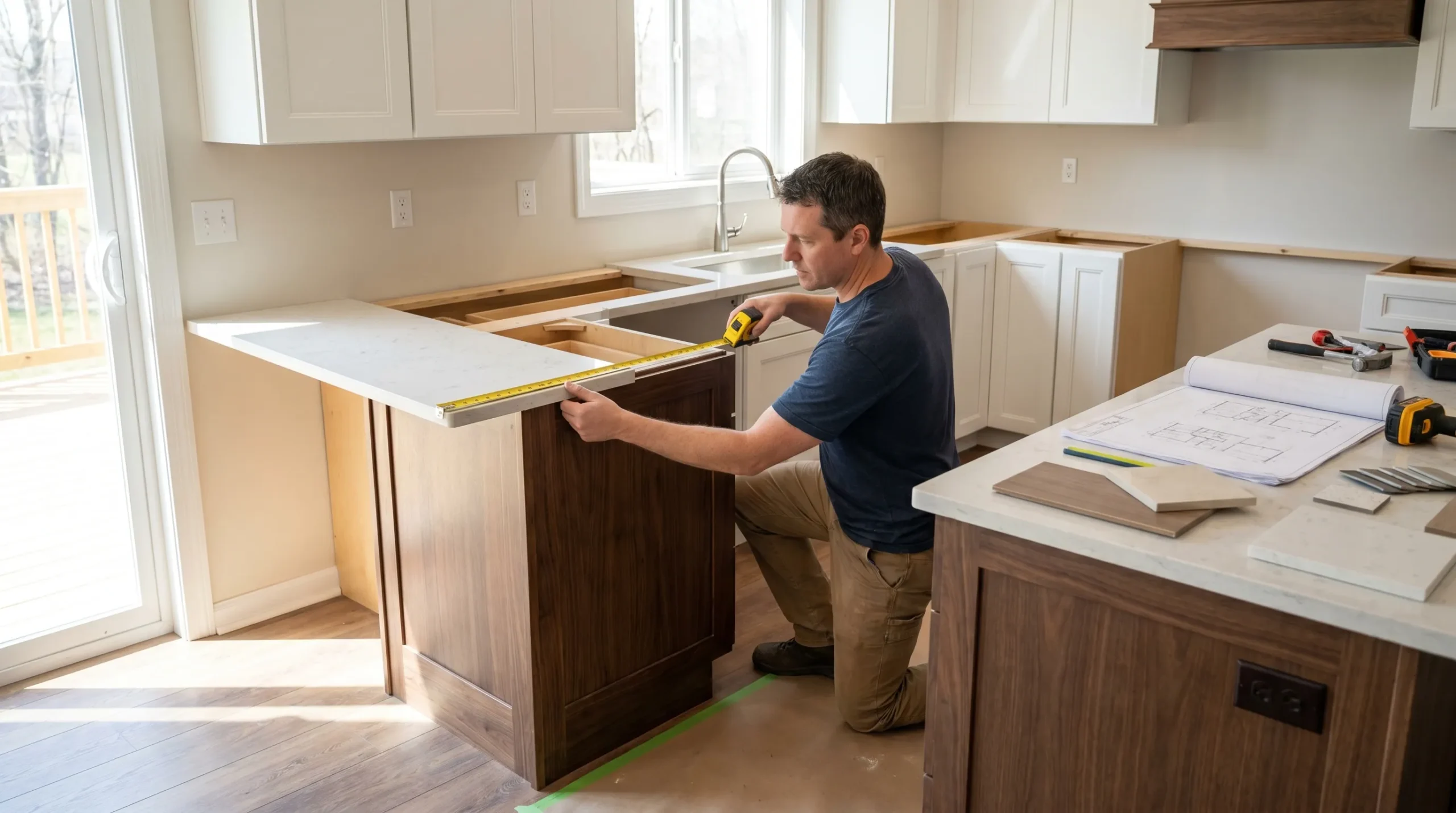
In most kitchens, the standard base cabinet box depth is 24 inches, and the finished countertop depth usually ends up around 25 to 25.5 inches once a typical 1 to 1.5 inch overhang is added. That is the short answer most homeowners want, but it is not the whole story. Cabinet depth can be measured in more than one way, and that is exactly why so many remodelers, DIY shoppers, and first-time buyers get confused.
If you are planning a remodel, replacing old cabinets, fitting a new dishwasher or sink base, or trying to make a small kitchen feel less cramped, knowing the actual kitchen cabinet depth matters. The right depth affects storage capacity, traffic flow, appliance fit, countertop overhang, and even how comfortable the kitchen feels when you work in it.
This guide explains the standard kitchen cabinet depth, the difference between cabinet box depth vs finished depth, how to measure correctly, when reduced-depth base cabinets make sense, and when deeper custom options are worth considering.
Standard Kitchen Base Cabinet Depth
The industry-standard answer is simple: base cabinet depth is usually 24 inches. That 24-inch measurement refers to the cabinet box, not the countertop edge. Manufacturer sizing guides and cabinet dimension references consistently use 24 inches as the standard for base cabinets.
To put that in context, wall cabinets are commonly 12 inches deep, while tall or pantry cabinets often come in 12-inch and 24-inch depths depending on the design. That is why the phrase standard kitchen cabinet dimensions often includes a full comparison across base, wall, and tall units rather than looking at one cabinet type in isolation.
So if your question is simply, “how deep are standard kitchen base cabinets?” the answer is 24 inches deep in most stock and semi-custom kitchen layouts. That is the benchmark other options are measured against.
Does Cabinet Depth Include Doors, Drawer Fronts, or the Countertop?
This is where a lot of searchers get tripped up. When cabinet brands and sizing guides say a base cabinet is 24 inches deep, they usually mean the cabinet box depth. The countertop overhang is a separate measurement. In practice, that means your kitchen may have a 24-inch base cabinet without countertop, but a deeper finished front edge once the counter is installed.
In many real kitchens, the counter extends about 1 to 1.5 inches beyond the front face of the base cabinets. That is why finished depth often lands around 25 to 25.5 inches, and some guides round it up to 26 inches depending on the material and profile.
Doors, drawer fronts, and hardware can also affect the way the cabinet feels in the room, even if the listed spec is based on the box. That is why cabinet box depth vs finished depth is such an important distinction. When people ask “does cabinet depth include doors?” or “does cabinet depth include drawer fronts?” they are really asking for the difference between spec-sheet depth and what they will experience day to day. The safest approach is to confirm whether you are measuring the box, the face, or the countertop edge.
Base Cabinet Depth With Countertop: The Finished Depth
A standard kitchen countertop is usually cut to about 25 to 25.5 inches deep to create a normal front overhang over a 24-inch cabinet base. That overhang is not just for looks. It helps protect cabinet faces from drips, gives a cleaner visual line, and creates a more comfortable working edge.
That means if you are comparing products or measuring an existing kitchen, you should think in two layers:
| Measurement | Typical size |
|---|---|
| Base cabinet box depth | 24 inches |
| Countertop overhang | 1 to 1.5 inches |
| Finished countertop depth | 25 to 25.5 inches |
This distinction matters when you are planning appliance alignment, checking clearances, or deciding whether a tighter kitchen can handle standard dimensions. It is also why phrases like kitchen base cabinet depth with countertop and cabinet depth vs counter depth matter so much in search.
Standard Kitchen Cabinet Depths by Cabinet Type
Even though this article is focused on how deep are kitchen base cabinets, readers often want the full dimension picture. That is why competitor pages and manufacturer guides almost always compare cabinet types.
Base cabinets
Base cabinets are generally 24 inches deep and around 34.5 inches high before the countertop is installed. Once the top is added, the finished work surface often reaches roughly 35 to 36 inches high.
Wall cabinets
Wall cabinets are usually 12 inches deep, which keeps them usable without pushing too far over the work surface. Some designs go deeper, especially for special storage or appliance-related layouts, but 12 inches deep is the most common standard.
Tall and pantry cabinets
Tall cabinets and pantry cabinets are often available in 12-inch and 24-inch depths. Deeper pantry storage may be useful, but there is a balance between maximizing storage and keeping items accessible.
This section naturally supports related terms like wall cabinet depth, upper cabinet depth, tall cabinet depth, and pantry cabinet depth, which is one reason it appears so often in ranking content.
How to Measure Kitchen Base Cabinet Depth Correctly?
If you want an accurate answer for your own kitchen, measure carefully. First, measure the cabinet box depth from the back of the cabinet to the front face of the box itself. Then measure again to the front of the countertop if the counter is already installed. That second measurement gives you the finished depth.
If you are shopping online, check whether the spec sheet refers to cabinet box depth, overall cabinet depth, or countertop depth. That small wording difference can save you from ordering the wrong product. If you are replacing cabinets around existing appliances, also measure the dishwasher opening, sink base, and nearby clearance rather than assuming all products are truly interchangeable.
For metric conversions, a 24-inch base cabinet is about 610 mm, while a 25-inch finished countertop depth is about 635 mm. Those conversions are useful if you are comparing imported cabinetry or reading European specs.
Why 24 Inches Became the Standard?
The 24-inch rule for base cabinets did not appear by accident. It works because it offers a strong balance between storage, reach, countertop support, and appliance compatibility. A shallower cabinet gives up storage quickly, while a deeper one can make the back of the cabinet harder to reach and may interfere with circulation in smaller kitchens.
It also lines up well with the way kitchens are typically used. Standard base depth supports common sink and appliance layouts while keeping the finished counter in a practical range for prep work. That is why the same number keeps appearing across manufacturer guides, dimension charts, and planning resources.
When Standard Base Cabinet Depth Does Not Work?
Even though 24 inches deep is standard, it is not automatically right for every kitchen.
In a small kitchen or galley kitchen, shaving depth can improve movement. NKBA planning guidance says a walkway should be at least 36 inches wide, and a work aisle should be at least 42 inches for one cook or 48 inches for multiple cooks. In tight spaces, even a few inches matter.
That is where reduced-depth base cabinets can help. In compact layouts, some homeowners choose cabinets around 18 to 21 inches deep rather than the standard 24 inches. This can be especially helpful on secondary runs, coffee stations, laundry-style storage walls, or tight apartment kitchens where traffic flow matters more than maximum storage.
On the other hand, deeper custom cabinets may make sense in select situations. A large island, a pantry-focused wall, or a custom design with extra-deep storage can use 27-inch base cabinets or even 30-inch options, but these are less standard and should be planned carefully so the kitchen does not feel crowded.
Shallow vs Standard vs Deep Base Cabinets Compared
A simple comparison makes the choice easier:
| Base cabinet depth | Best for | Trade-off |
|---|---|---|
| 18–21 inches | Small kitchens, tight walkways, secondary storage | Less storage volume |
| 24 inches | Most kitchens, standard layouts, easiest appliance fit | None in typical layouts |
| 27–30+ inches | Large custom kitchens, islands, special storage | Harder reach, more space required |
If you are wondering “can you use 21 inch deep base cabinets?” the answer is yes, in the right design. They are not the default, but they can be a smart solution where a full-depth run would pinch circulation. If you are asking whether deeper base cabinets are better, the answer is only sometimes. More depth increases storage, but it can also reduce comfort and usable floor space.
This is where the best cabinet depth comparison chart mindset helps: there is no single perfect depth for every room, only the best match for your layout and goals.
Base Cabinet Depth for Sinks, Dishwashers, and Other Appliances
Cabinet depth becomes even more important when appliances enter the picture. Standard base depth works well because it aligns with common kitchen equipment and plumbing setups. That is one reason 24-inch depth is so resilient as a standard.
For example, a typical kitchen plan often includes a standard-depth sink base cabinet, nearby prep space, and a dishwasher opening sized to work within the same overall cabinet run. If you go too shallow, appliance integration can become more complicated. If you go too deep, the workflow may feel less efficient unless the room is large enough to support it.
This is especially true around ranges, wall ovens, and refrigerator-adjacent cabinetry. The more custom your layout becomes, the more important it is to verify actual product dimensions rather than assuming all cabinets and appliances follow one universal standard.
Accessibility, Reach, and Aging-in-Place Considerations
Standard cabinet depth is not always the best choice for accessibility. NKBA access guidance notes that a kitchen should provide a walkway width of at least 36 inches, and accessible clearances may require more space and more intentional planning.
For seated use, NKBA guidance also specifies knee clearance requirements, including 27 inches of clear height and a minimum depth allowance under the counter in accessible situations. These details matter if you are planning a kitchen for wheelchair use, aging in place, or multi-generational living.
In these cases, the question is not just “what is the standard base cabinet depth?” but “what base cabinet depth for wheelchair access or limited reach makes the kitchen safer and easier to use?” Sometimes that leads to modified depths, open knee spaces, or more drawer-based storage instead of very deep shelving.
Common Mistakes to Avoid When Choosing Base Cabinet Depth
One common mistake is confusing standard base cabinet depth with finished countertop depth. If you order based on the wrong number, your kitchen may not line up the way you expect.
Another mistake is choosing cabinets based only on storage. More storage sounds great, but if the kitchen loses walkway clearance or becomes harder to work in, the design can feel worse, not better. NKBA guidance exists for a reason: circulation and work zones matter.
A third mistake is assuming every kitchen in every region uses identical specs. U.S. kitchens are usually discussed in inches, while imported or European systems may use metric sizing or slightly different conventions. Always confirm whether you are looking at inches, millimeters, or a cabinet system built around another standard.
U.S. vs Metric Cabinet Depth: Inches, Millimeters, and Centimeters
If you shop across markets, conversions help. A 24-inch base cabinet depth is roughly 610 mm. A finished countertop depth of 25 to 25.5 inches is about 635 to 648 mm. Some European-style descriptions use 60 cm as a shorthand reference for base-unit depth, which is close to the same overall planning zone.
That means searchers using terms like standard base cabinet depth in mm or base cabinet depth in cm are usually asking about the same basic standard, just in a different measurement language. Adding both units in an article makes it more useful and more search-friendly.
Quick Depth Chart: Kitchen Base Cabinets at a Glance
Here is the easiest way to remember it:
| Type | Typical depth |
|---|---|
| Reduced-depth base cabinet | 18–21 inches |
| Standard base cabinet | 24 inches |
| Finished countertop depth | 25–25.5 inches |
| Deep/custom base cabinet | 27–30+ inches |
That small chart answers a surprising number of related searches, including standard and shallow base cabinet depths, 24 inch base cabinet actual depth, and deep base cabinets pros and cons.
Conclusion
The best direct answer to how deep are kitchen base cabinets is still the simplest one: standard kitchen base cabinets are usually 24 inches deep. Once you add the countertop, the finished depth is often about 25 to 25.5 inches with a normal overhang.
But the smarter answer is that depth should match the kitchen. In a compact layout, 18 to 21 inches may work better. In a large custom design, 27 to 30+ inches may be worth considering. The key is understanding the difference between cabinet box depth, countertop depth, and the clearances your kitchen needs to stay functional, comfortable, and easy to use.
FAQs About Kitchen Base Cabinet Depth
Are kitchen base cabinets always 24 inches deep?
No, but 24 inches is the standard most kitchens use. Shallower and deeper options exist for special layouts, compact rooms, and custom designs.
Does 24 inches include the countertop?
Usually no. 24 inches typically refers to the cabinet box depth. The countertop usually extends beyond that with about a 1 to 1.5 inch overhang.
What is the finished depth with countertop?
Most finished counters over standard base cabinets end up around 25 to 25.5 inches deep, and some sources round that to 26 inches depending on profile and installation details.
Can base cabinets be 21 inches deep?
Yes. 21-inch reduced-depth base cabinets can work well in narrow kitchens, secondary storage runs, or layouts where every inch of aisle space matters.
What is the standard base cabinet depth in mm?
A standard 24-inch base cabinet is about 610 mm. A finished counter depth of 25 inches is about 635 mm.
Are deeper base cabinets better?
Not automatically. They provide more storage, but they can reduce reach comfort and take up more floor space. In many kitchens, 24 inches remains the best balance.
Disclaimer:
This article is for general informational purposes only. It explains standard kitchen base cabinet depths, finished countertop measurements, and layout considerations, which may vary by manufacturer, design, and kitchen size. Readers should verify dimensions before purchasing or remodeling.