

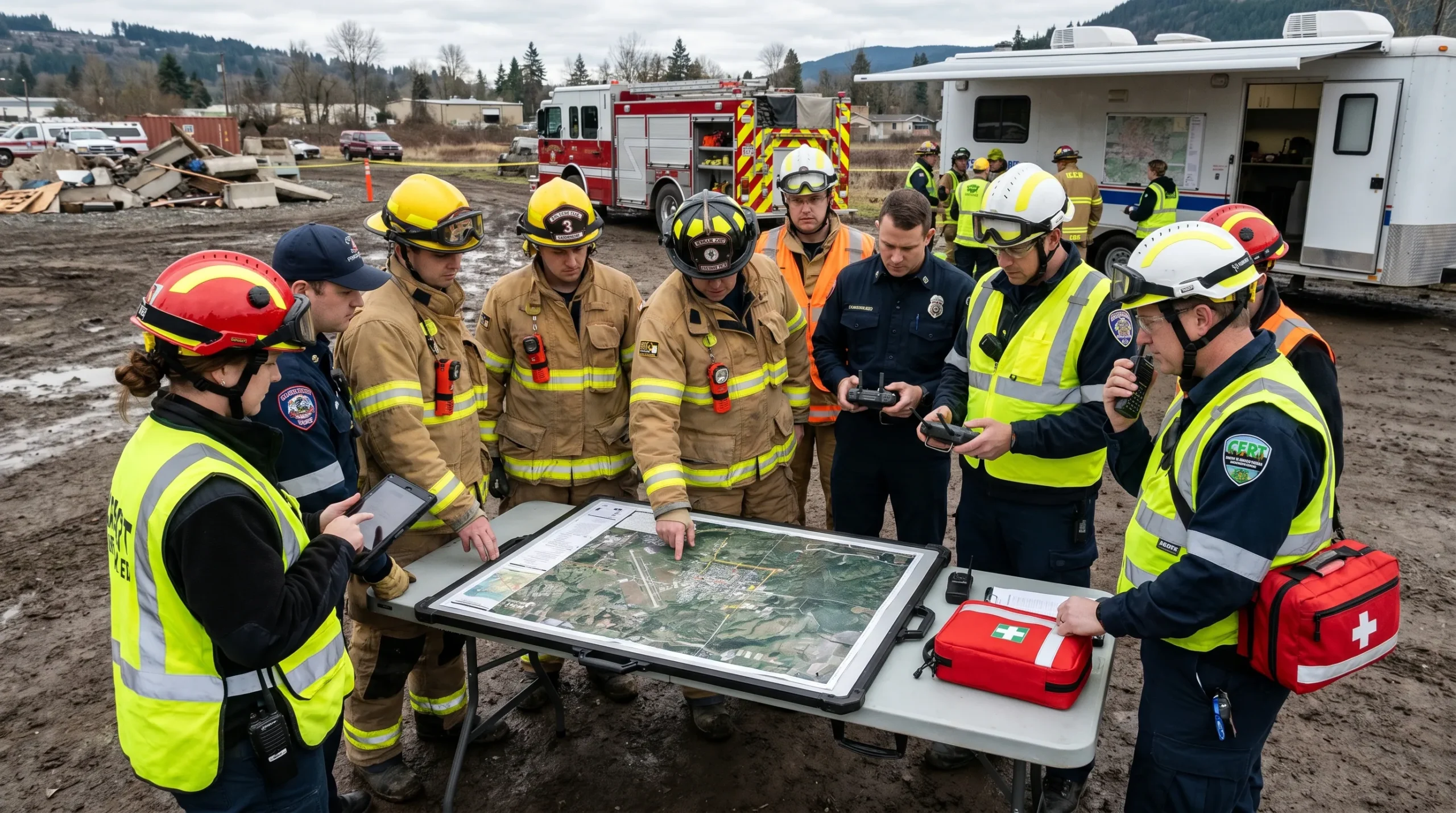
When disasters hit, crews are expected to make fast decisions, protect lives, manage chaos, and keep operations moving under pressure. That is why empowerment cannot stop at motivation alone. It has to include preparedness, equipment, role clarity, local coordination, and continuous learning. FEMA’s CERT guidance emphasizes training communities for the hazards they are likely to face, OSHA stresses that responders need the right equipment and safety preparation before emergencies happen, and IFRC highlights that mental health and psychosocial support should be part of emergency response rather than an afterthought.
What is a disaster management crew?
A disaster management crew is the group of people responsible for helping communities prepare for, respond to, and recover from emergencies. That can include emergency responders, firefighters, paramedics, medical personnel, search and rescue teams, local officials, trained volunteers, and community-based support teams. In many places, these crews work across the full cycle of preparedness, response, recovery, and mitigation, not just the immediate emergency window.
This matters for SEO and for readers because the phrase sounds simple, but the role is broad. A well-functioning crew may handle evacuation support, first aid, temporary shelter coordination, hazard communication, resource allocation, and post-disaster recovery tasks. FEMA’s CERT materials reflect this broader model by teaching volunteers what to do before, during, and after the hazards that may occur where they live.
Why empowerment matters more than good intentions
Many organizations make the same mistake: they create a plan, write a protocol, and assume the team is ready. But in real emergencies, crews succeed when they are trained, equipped, trusted, and supported. Empowerment improves response speed, reduces confusion, strengthens morale, and helps teams make better decisions in difficult conditions.
It also makes disaster response more sustainable. If people are overworked, under-equipped, or emotionally drained, the system weakens fast. OSHA’s preparedness guidance is clear that emergency operations can expose workers to serious hazards, which means empowerment has to include protective equipment, safe work practices, and readiness measures before a crisis begins.
1. Build advanced training, drills, and hazard-specific readiness
One of the strongest ways to empower the disaster management crew is through advanced training and education. Not generic workshops. Not one-time orientation. Real, recurring, practical training that reflects the risks crews will actually face.
That includes simulation exercises, cross-agency drills, and hazard-specific training for events such as floods, earthquakes, wildfires, storms, and heatwaves. FEMA’s training resources and CERT framework both support a model where people are educated for the specific hazards in their communities, while UNDRR’s training work focuses on building local-level capacity to design and implement resilience strategies.
A strong training culture also reduces the implementation gap that many teams face. It is one thing to know the procedure on paper. It is another to apply it under stress. Practical drills improve situational awareness, reinforce defined roles and responsibilities, and help crews act with confidence when conditions change quickly.
A useful model is a 3-tier response approach:
- Basic preparedness training for all staff and volunteers
- Role-specific operational training for field teams and coordinators
- Multi-agency exercises for leadership, communications, and logistics
That kind of structure gives teams both depth and flexibility.
2. Give crews the right technology and real-time information
Technology for enhanced response should never replace good judgment, but it can dramatically improve it. Teams work better when they have access to real-time data, GIS, drones, GPS tracking systems, mobile communication apps, and reliable disaster management software.
These tools matter because disasters create information gaps. Crews need to know where people are trapped, which roads are blocked, what supplies are running low, and which neighborhoods face the highest risk. Good tools improve situational awareness and reduce delays caused by manual reporting. UNDRR’s local resilience work also emphasizes practical tools and planning systems that help local authorities move from awareness into implementation, while its broader Sendai Framework materials focus on reducing risk and increasing resilience through stronger systems.
For many teams, the best technology is not the flashiest option. It is the tool that works in the field. That might mean:
- a shared incident dashboard
- a 2-way radio backup system
- a mobile app for status updates
- a clear SOP repository
- a simple digital workflow for task tracking
The key is to choose field-ready digital tools that reduce friction rather than create it.
3. Strengthen leadership, role clarity, and field decision-making
Strong leadership and decision-making are repeated across nearly every competitor for a reason: they are central to effective disaster response. In an emergency, people need to know who is in charge, what their role is, and how decisions will be made.
Empowerment grows when crews have a clear chain of command, authority to act, and leaders who can communicate under pressure. This is where an incident command system, even in a simplified local form, becomes a major advantage. Competitors barely covered this directly, but it is one of the most practical gaps to fill. A strong system turns leadership from personality into structure.
Teams do better when leaders are trained in:
- delegation
- rapid decision-making
- risk communication
- resource prioritization
- after-action learning
That kind of leadership is also more inclusive. It gives field leaders enough authority to solve real-time problems without waiting for every approval, while still keeping accountability in place.
4. Make mental health part of operational readiness
Mental health support for disaster responders should not sit in a separate wellness folder that nobody opens. It should be part of the operational plan. IFRC’s guidance is especially clear here: emergency settings often expose people to distressing events, and support can range from basic psychological first aid to more specialized mental health care.
For disaster teams, this means empowerment must include:
- psychological first aid
- peer check-ins
- structured debriefing
- burnout prevention
- trauma-informed responder support
- access to follow-up care when needed
This is not only about compassion. It is about performance. A team that is emotionally exhausted makes poorer decisions, communicates less clearly, and becomes harder to retain over time.
A simple practice can make a difference: hold a 20-minute peer-led debrief within 24 to 48 hours after a mission, then follow it with a short 3-question debrief survey. That creates space for emotional processing and for practical improvement at the same time. While that exact process is a recommended operational addition rather than an official standard, it fits the broader responder-support principles reflected in IFRC’s MHPSS approach.
“Mental health and psychosocial support” should be treated as part of the response system, not a side issue.
5. Improve communication, coordination, and volunteer integration
Interagency collaboration and coordination are where many disaster systems either become effective or fall apart. Even capable teams struggle when communication channels are weak, volunteer roles are unclear, or agencies operate in separate silos.
Empowering the disaster management crew means building strong communication systems before the disaster starts. That includes an emergency communications plan, shared terminology, contact trees, backup channels, and clear rules for who communicates what. Regroup’s community preparedness content shows how important evacuation notices, weather warnings, and all-clear notices are for practical action, while FEMA’s CERT model reinforces the value of organized local participation.
Volunteer management is just as important. Volunteers are valuable, but without onboarding and role clarity they can increase confusion. Better systems use:
- short onboarding workflows
- defined role cards
- simple safety instructions
- local support teams such as CERT-style groups
- mutual aid agreements between agencies and municipalities
This is where community resilience begins to support the crew instead of burdening it.
6. Ensure equipment, PPE, logistics, and supply readiness
Adequate resources and equipment are not optional. They are part of trust. Crews feel empowered when they know the system will protect them and support them with what they need.
OSHA notes that emergency preparedness may require engineering controls, work practices, and PPE to reduce exposure, and its PPE guidance lists examples such as gloves, hard hats, respirators, coveralls, and other protective equipment depending on the hazard. OSHA’s emergency response PPE materials also explain that emergency response PPE can be classified into four levels, from Level A to Level D, depending on the risk.
That means logistics planning should cover:
- personal protective equipment
- medical supplies
- transportation vehicles
- communications devices
- clean water and shelter support
- resource pre-positioning
- a 72-hour emergency supply plan
Below is a simple readiness table you can use in the article:
| Area | What crews need | Why it matters |
| Safety | PPE, respirators, gloves, helmets | Reduces injury and exposure |
| Medical | First aid kits, trauma supplies, stretchers | Supports rapid lifesaving care |
| Mobility | Vehicles, fuel, route maps | Keeps teams moving during disruption |
| Communication | Radios, backup phones, alerts | Prevents coordination failure |
| Logistics | Stockpiles, supply tracking, shelter items | Sustains operations over time |
7. Empower communities so crews are not working alone
A strong disaster crew should not carry the full burden alone. One of the smartest empowerment strategies is to improve community engagement and awareness so local people can prepare better, support response operations, and reduce avoidable pressure on responders.
FEMA’s CERT program is built on this idea. It educates volunteers about local hazards and prepares them to help safely when emergencies happen. UNDRR also stresses that resilience starts at the local level, and its local resilience work promotes a whole-of-society approach along with peer support among municipalities.
This creates real benefits. Communities that understand evacuation routes, shelter information, early warnings, and household preparedness are easier to protect during a crisis. That gives disaster teams more room to focus on the highest-risk needs.
A useful mini case example is a flood-prone district that trains local volunteers before monsoon season. When flooding begins, those volunteers can help with basic alerts, route guidance, and household checks, while professional crews focus on rescue, medical aid, and logistics. That is community-based disaster risk reduction in action.
8. Use feedback, metrics, and after-action reviews to keep improving
Continuous improvement is one of the most overlooked parts of empowerment. Teams often rush from one emergency to the next without turning experience into better systems.
A stronger approach is to build after-action review processes into normal operations. After major incidents, teams should examine:
- what worked
- where delays happened
- what tools failed
- where communication broke down
- which skills need more training
- how responders felt during and after the mission
UNDRR and FEMA training ecosystems both support the broader idea that resilience and preparedness improve through structured learning and capacity development, not just one-off plans.
Useful operational readiness metrics might include:
- training completion rates
- drill participation
- response time
- communication failure rates
- PPE availability
- volunteer retention
- post-incident improvement actions completed within 90 days
Those are the kinds of practical metrics competitors largely missed.
What most competitors miss: ICS, emerging risks, retention, and inclusion
This is where your article can become stronger than the current SERP leaders.
First, most competitors talk about leadership but not enough about incident command systems, emergency operations centers, or standard operating procedures. Those are the structures that make leadership reliable during real incidents.
Second, they rarely address emerging risks. Disaster readiness today is not only about earthquakes and floods. It also includes heatwaves, compound events, and climate-driven stress on local systems. UNDRR’s local resilience work and Sendai Framework materials support a longer-term risk-reduction approach, while GFDRR- and resilience-style content in the broader ecosystem points toward planning for changing local hazards rather than reacting only after impact.
Third, competitors mention mental health but not enough about crew welfare and retention. Empowerment fails if skilled responders leave because of burnout, unsafe conditions, or no career pathway. Retention deserves its own strategy.
Fourth, inclusive disaster risk management is still underused in exact-match content. Yet local resilience guidance increasingly stresses planning that works for women, persons with disabilities, and other high-risk groups. Stronger inclusion improves both public outcomes and crew effectiveness because teams can respond with fewer blind spots.
A practical 7-point crew empowerment checklist
If you want a simple answer to how can we empower the disaster management crew, start here:
- Train continuously, not occasionally
- Use hazard-specific drills and multi-agency exercises
- Provide the right technology, PPE, and logistics support
- Build clear leadership, ICS-style role clarity, and fast decision-making
- Make mental health and psychosocial support part of operations
- Strengthen communication, volunteer integration, and community preparedness
- Track results with after-action reviews and readiness metrics
This checklist works because it combines the human side of response with the operational side. That balance is what many competitors only partially deliver.
Conclusion
How can we empower the disaster management crew is not just a broad awareness question. It is a practical leadership question, a safety question, a training question, and a resilience question. The most effective teams are empowered by advanced training, real-time information, strong communication systems, adequate resources and equipment, mental health support, and community partnerships.
FEMA’s CERT model shows the value of local preparedness, OSHA reminds us that worker safety and PPE readiness are essential, and IFRC demonstrates why mental health and psychosocial support belong in every serious emergency response system. Put together, those lessons point to one clear conclusion: the best way to strengthen disaster response teams is to build a system that prepares people before disaster strikes, protects them during the mission, and supports learning and recovery afterward.
Disclaimer:
This content is for general informational purposes only. Disaster response practices may vary by region and situation. Always follow official emergency services, government guidelines, and trained professionals during real events. It should not replace certified training or professional advice.