

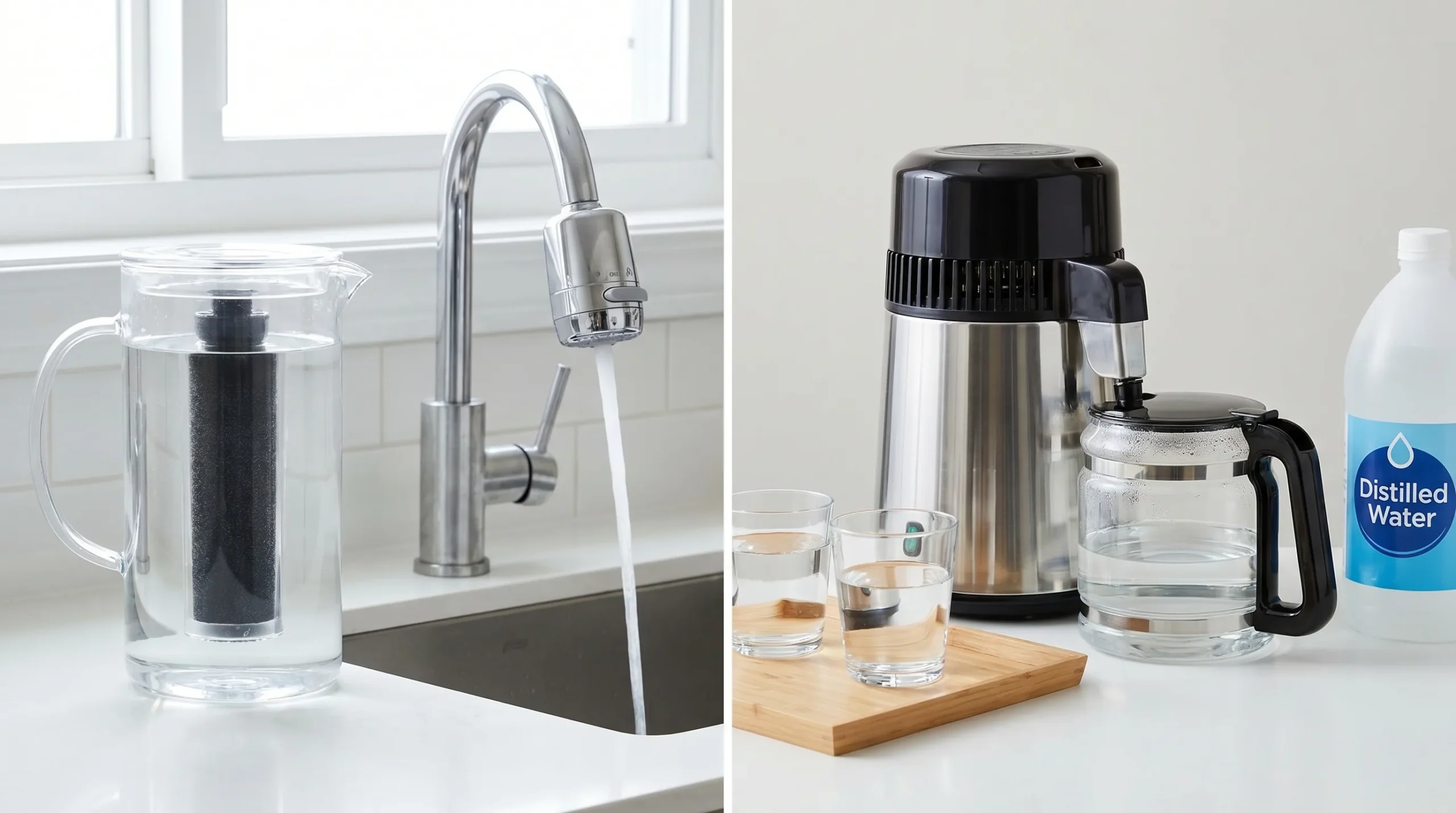
Is filtered water the same as distilled water? No, filtered water and distilled water are not the same, even though both are treated to improve water quality. Filtered water passes through a water filtration system that removes selected contaminants, such as chlorine, sediment, bad taste, odor, and sometimes heavy metals or microplastics, depending on the filter type. Distilled water, on the other hand, is made through the distillation process, where water is boiled into steam and then condensed back into liquid, leaving behind many minerals, salts, and impurities.
The main difference comes down to how the water is treated and what remains afterward. Filtered water often keeps some beneficial minerals like calcium, magnesium, and potassium, while distilled water is usually much closer to mineral-free water or nearly pure H2O. That is why filtered water is commonly used for daily drinking and cooking, while distilled water is often recommended for humidifiers, CPAP machines, steam irons, steamers, car batteries, laboratories, and medical-style uses.
Quick Answer: Is Filtered Water the Same as Distilled Water?
No, filtered water is not the same as distilled water. Both can be cleaner than untreated tap water, but they are made in different ways and are used for different purposes.
Filtered water is created by passing tap water or source water through a filter. The filter may use activated carbon, a sediment filter, a ceramic filter, reverse osmosis, UV light, or another filtration method. Depending on the system, filtered water may reduce chlorine taste, chlorine smell, rust, dirt, lead, VOCs, PFAS, bacteria, viruses, pesticides, herbicides, and other impurities. However, not every filter removes the same things.
Distilled water is made by boiling water, collecting the steam, and cooling that steam back into liquid. During this process, many dissolved minerals and salts are left behind. This is why distilled water is often described as nearly 100% pure H2O, although real-world purity depends on the distillation equipment and storage conditions.
For most everyday uses, filtered water is better for drinking because it usually tastes fresher and may retain minerals. Distilled water is better when mineral-free water is needed, especially for appliances that can be damaged by limescale buildup, calcium scale, or mineral deposits.
Filtered Water vs Distilled Water: Main Difference at a Glance
The easiest way to understand filtered water vs distilled water is to compare the process, taste, mineral content, and best uses.
| Feature | Filtered Water | Distilled Water |
| Process | Passed through filter media | Boiled, evaporated, and condensed |
| Minerals | Often retains some minerals | Removes most minerals |
| Taste | Usually fresh or normal | Often flat or bland |
| Best for | Drinking, cooking, coffee, tea | Appliances, CPAP machines, irons |
| Contaminant removal | Depends on filter type | Removes many minerals and impurities |
| Convenience | Easy for daily household use | Slower or bought in jugs |
| Cost | Often cheaper over time | Can cost more per gallon |
| Appliance use | May still cause scale | Better for mineral-free uses |
The key point is that water filtration vs distillation is not a small technical difference. Filtration targets certain contaminants based on the filter design. Distillation changes water into steam and then back into liquid, which removes many dissolved solids.
So, when someone asks, “What is the difference between filtered and distilled water?”, the answer is simple: filtered water is cleaned through a filter, while distilled water is purified through boiling and condensation.
What Is Filtered Water?
Filtered water is water that has passed through one or more filters to reduce unwanted substances. It may start as tap water, municipal water, well water, or another source. The exact quality depends on the original water and the filtration system used.
A basic activated carbon filter can improve taste and smell by reducing chlorine, chlorine odor, and some volatile organic compounds, often called VOCs. A sediment filter may trap rust, dirt, sand, and particles. A ceramic filter can block certain fine particles and microorganisms. A reverse osmosis system uses a semi-permeable membrane to reduce dissolved solids, heavy metals, nitrates, fluoride, and other contaminants. Some systems also use UV filtration to target bacteria and viruses.
This is why the question “what does water filtration remove?” does not have one universal answer. A pitcher filter, faucet filter, refrigerator filter, under-sink system, countertop filter, and whole-house water filter can all perform differently.
Filtered water usually keeps some naturally occurring minerals, depending on the system. That can be a benefit for taste because minerals such as calcium, magnesium, and potassium can make water feel less flat. For daily hydration, cooking, coffee, and tea, filtered water is often a practical and pleasant option.
What Is Distilled Water?
Distilled water is water that has gone through distillation. In this process, water is heated until it reaches its boiling point and becomes steam. The steam is then cooled and condensed back into liquid form. Many dissolved minerals, salts, metals, and other impurities stay behind in the boiling chamber.
This process explains why distilled water is often used where mineral-free water matters. It is common in laboratories, medical settings, steam irons, humidifiers, CPAP machines, and some automotive uses such as batteries. Because the distillation process removes most dissolved minerals, distilled water helps reduce scale buildup and mineral deposits.
A common long-tail search is “how distilled water is made”, and the answer is: through boiling, evaporation, steam collection, and condensation. Another common question is “what does distillation remove?” Distillation removes many minerals, salts, and non-volatile contaminants, but proper equipment and storage matter because water can be re-contaminated after treatment.
Distilled water usually has a neutral pH near 7 when freshly made, but it may absorb carbon dioxide from the air and become slightly acidic over time. It is still generally considered safe to drink, but because it lacks minerals, many people find the taste flat or bland.
How Filtration and Distillation Remove Contaminants Differently
Filtration and distillation both improve water quality, but they work in very different ways.
Water filtration depends on the filter media. Activated carbon works through adsorption, which helps trap certain chemicals and improve taste. Reverse osmosis uses pressure and a membrane to reduce many dissolved contaminants. UV light does not physically remove minerals, but it can help inactivate certain microorganisms. Ceramic and sediment filters physically block particles based on pore size or micron filtration.
Because filtration methods vary, a filter might reduce chlorine but not fluoride. Another might reduce lead but not bacteria. A high-quality reverse osmosis system may reduce total dissolved solids, while a simple pitcher filter may mostly improve taste and odor.
Distillation works by turning water into steam. Many contaminants, including minerals such as calcium and magnesium, do not evaporate with the water and are left behind. This is why distilled water has very low mineral content. However, some volatile chemicals can evaporate at similar temperatures, so distillers may include vents or carbon post-filters for better performance.
A smart way to choose between filtered and distilled water is to ask: What problem am I trying to solve? If your issue is chlorine taste, filtered water may be enough. If your issue is mineral buildup in a humidifier, distilled water is usually the better choice.
Mineral Content: Does Filtered Water or Distilled Water Have Minerals?
Mineral content is one of the biggest differences in distilled water vs filtered water.
Distilled water removes most minerals and electrolytes, including calcium, magnesium, potassium, sodium, and other dissolved minerals. This is why it is useful for appliances that need mineral-free water. However, it also explains why distilled water often tastes flat.
Filtered water may still contain minerals, especially if the filter is a carbon filter, sediment filter, or basic faucet filter. Some filtration systems are designed to reduce contaminants while leaving beneficial minerals in place. Reverse osmosis removes more dissolved minerals than many common filters, but some RO systems add minerals back through a remineralisation filter.
So, does distilled water have minerals? Usually, very few. Does filtered water remove minerals? Sometimes, but not always. It depends on the filtration method.
For drinking, mineral content is not only a health topic; it is also a taste topic. Minerals can make water taste fuller, fresher, or more natural. That is one reason bottled water brands sometimes add minerals back for taste.
Which Is Better for Drinking: Filtered Water or Distilled Water?
For most people, filtered water is better for everyday drinking than distilled water. It can improve the taste and smell of tap water while keeping some minerals. It is also more convenient for daily hydration, cooking, coffee, tea, and general household use.
Distilled water is generally safe to drink, but it is not usually necessary as your main drinking water. Since it lacks minerals, it may taste flat. Some people also worry about whether distilled water can affect mineral balance. For healthy adults eating a normal diet, most minerals come from food, not water. Still, many people prefer filtered water because it tastes better and feels more natural.
The better question is not simply “Is distilled water safe to drink?” but “Which water is better for my situation?” If your local tap water tastes bad because of chlorine, a certified carbon filter may help. If your water has lead, PFAS, nitrates, or other specific contaminants, you need a filter certified for those problems. If you need water for a CPAP humidifier chamber or steam iron, distilled water may be the better choice.
For daily drinking, filtered water usually offers the best balance of taste, convenience, mineral content, and cost.
Taste Difference: Why Does Distilled Water Taste Flat?
Distilled water often tastes flat because it has very few minerals. Minerals like calcium and magnesium help give water its natural taste. When those minerals are removed, the water can feel bland or empty.
Filtered water usually tastes better because filtration can reduce unpleasant elements like chlorine taste, chlorine smell, sediment, and odors while still leaving some minerals behind. This is why many people prefer filtered water for drinking, cooking, coffee, and tea.
Bottled water companies understand this taste issue. Some purified or reverse osmosis bottled waters have minerals added back to improve flavor. That does not mean distilled water is unsafe; it simply means taste is affected by mineral content.
If your main goal is better-tasting drinking water, filtered water is usually the more satisfying option. If your main goal is mineral-free water, distilled water is more appropriate.
Can You Use Filtered Water Instead of Distilled Water?
You can use filtered water instead of distilled water in some situations, but not all.
For drinking, cooking, coffee, tea, and general household use, filtered water can usually replace distilled water. In fact, it is often preferred because it tastes better and is easier to use every day.
For appliances, the answer changes. If a device specifically says to use distilled water, it is usually because minerals in regular or filtered water can cause scale. Even filtered water may still contain dissolved minerals. Over time, those minerals can leave deposits, clog small parts, or create white dust.
Reverse osmosis water may be closer to distilled water than basic filtered water because it removes more dissolved solids. However, it is not always identical to distilled water. If you are using water in a medical device, CPAP machine, humidifier, iron, or steamer, it is best to follow the manufacturer’s instructions.
A simple rule is this: filtered water is usually fine for people; distilled water is often better for machines that require mineral-free water.
Best Water for Appliances: Humidifiers, CPAP Machines, Irons, and Steamers
Many searches for filtered water vs distilled water come from people trying to protect appliances. This is where the difference really matters.
Humidifiers often work better with distilled water because mineral-rich water can create white dust. This white dust comes from minerals released into the air when water is misted. Filtered water may reduce some contaminants, but it can still contain calcium, magnesium, and other dissolved minerals.
CPAP machines commonly recommend distilled water for the humidifier chamber. The reason is not only cleanliness but also scale prevention. Minerals can build up inside the water chamber and make cleaning harder.
Steam irons and clothes steamers also benefit from distilled water. Mineral buildup can clog steam vents and reduce appliance life. If you live in a hard water region, filtered water may still leave limescale unless the filter removes dissolved minerals.
Coffee makers and kettles are slightly different. Filtered water is often a good choice because it improves taste. However, hard water can still cause scale, so descaling may be needed.
Here is a quick guide:
| Use | Better Choice | Why |
| Daily drinking | Filtered water | Better taste and convenience |
| Humidifier | Distilled water | Reduces white dust and mineral deposits |
| CPAP machine | Distilled water | Helps prevent scale in chamber |
| Steam iron | Distilled water | Reduces clogging |
| Coffee maker | Filtered water | Better flavor |
| Kettle | Filtered water, sometimes low-mineral water | Reduces taste issues and some scale |
| Car battery | Distilled water | Mineral-free water is preferred |
Is Purified Water the Same as Distilled or Filtered Water?
Purified water is not always the same as distilled water or filtered water. It is a broad term that means water has been treated to remove impurities. Distilled water can be considered a type of purified water, but purified water can also be made through reverse osmosis, deionization, or other purification methods.
This is why bottled water labels can be confusing. A bottle may say purified water, distilled water, spring water, mineral water, or filtered water. These terms do not always mean the same thing.
If the label says distilled, the water went through distillation. If it says reverse osmosis, it was purified through a membrane system. If it says spring water, it comes from a spring source and may still contain natural minerals. If it says filtered, the result depends on the filtration method.
When buying water, read the label carefully. Store-bought purified water is not automatically distilled water, and refrigerator filtered water is not distilled water either.
Filtered Water vs Distilled Water for Cooking, Coffee, Tea, and Baby Formula
For cooking, coffee, and tea, filtered water is usually the better choice. It can reduce chlorine taste and odor while keeping enough minerals to support flavor. Coffee and tea often taste dull when made with distilled water because minerals help extract flavor from coffee grounds and tea leaves.
For cooking, filtered water is convenient and practical. Pasta, soups, rice, sauces, and broths generally do not require distilled water. If your tap water has a strong smell or taste, filtered water can make food and drinks taste cleaner.
For baby formula, the answer depends on local guidance, water safety, and the baby’s needs. Some parents use filtered water, some use boiled tap water, and some use bottled or distilled water. The safest approach is to follow pediatric advice and local health guidance, especially for newborns or babies with special health concerns. Distilled water is not automatically required unless recommended, but water used for formula should always be safe and handled properly.
Filtered Water vs Distilled Water for Plants, Pets, and Aquariums
For most pets, safe filtered water is usually a good choice. If you drink the water safely, your dog or cat can often drink it too. However, pets with medical conditions may need special advice from a veterinarian.
For plants, the best choice depends on the plant. Many common houseplants do fine with filtered water. Sensitive plants, such as some orchids or carnivorous plants, may prefer distilled water or low-mineral water because minerals, chlorine, or salts can build up in the soil.
Aquariums are more complicated. You should not assume that filtered water or distilled water is automatically safe for fish. Fish tanks often need conditioned water with the right minerals, pH level, and chlorine or chloramine removal. Distilled water may need remineralisation before being used in an aquarium because fish and aquatic plants often need certain minerals.
So, for plants and pets, filtered water is often practical. For sensitive plants or specialized aquariums, water chemistry matters more than the label.
Cost, Convenience, and Environmental Impact
Cost is another major difference between filtered and distilled water. A home filtration system may cost more upfront, but it can be cheaper over time for daily drinking. You may need to replace cartridges, but you get convenient water at home without buying jug after jug.
Distilled water can be more expensive if you buy it by the gallon. A home water distiller can reduce store trips, but it uses electricity and takes time. Distillation is often an energy-intensive process, especially compared with basic filtration.
There is also an environmental angle. Buying bottled distilled water or bottled purified water creates plastic waste, especially if you use it daily. A home filter can reduce reliance on single-use plastic bottles. However, filters also need cartridge replacement, so maintenance still matters.
For most households, the practical approach is to use filtered water for daily drinking and buy or make distilled water only for specific uses like humidifiers, CPAP machines, or steam appliances.
How to Choose the Right Water Type for Your Situation
Choosing between filtered water and distilled water becomes easier when you match the water to the purpose.
Use filtered water for everyday drinking, cooking, coffee, tea, reducing chlorine taste, and general hydration. It is convenient, usually tastes better, and may retain beneficial minerals.
Use distilled water when you need mineral-free water. This includes humidifiers, CPAP machines, steam irons, clothes steamers, car batteries, and certain medical or laboratory-style uses.
Use reverse osmosis or purified water when you want broad contaminant reduction but do not necessarily need distilled water. Reverse osmosis can be helpful if your local water quality report shows concerns with dissolved solids, lead, nitrates, PFAS, or other contaminants.
The best choice depends on your water source, your health needs, and the device you are using. If the goal is taste, filtered water usually wins. If the goal is avoiding minerals, distilled water is usually safer.
Certification and Safety: What to Check Before Trusting a Water Filter
Not all water filters are equal. A filter that improves taste may not remove lead. A filter that removes sediment may not remove bacteria. This is why certification matters.
When choosing a filter, look for clear testing claims. Common standards include NSF/ANSI 42, often linked with chlorine taste and odor reduction; NSF/ANSI 53, often linked with health-related contaminants such as lead; NSF/ANSI 58, commonly used for reverse osmosis systems; and NSF/ANSI 401, often associated with emerging contaminants.
A certified water filter should clearly state what it reduces. If your concern is fluoride, PFAS, lead, bacteria, or VOCs, choose a filter tested for that exact issue.
It is also smart to check your local water quality report or consumer confidence report. This helps you choose a filter based on your actual water, not just marketing claims.
Common Myths About Filtered and Distilled Water
One common myth is that filtered water is always as pure as distilled water. That is not true. Some filtered water still contains minerals and dissolved solids.
Another myth is that boiled water is the same as distilled water. Boiling can kill many microorganisms, but it does not remove dissolved minerals the same way distillation does. Distilled water requires collecting and condensing steam.
Some people also think purified water always means distilled water. Again, not true. Purified water can be made through several treatment methods, including reverse osmosis and deionization.
Another myth is that all filters remove everything. A basic carbon filter may reduce chlorine taste but may not remove fluoride, lead, PFAS, bacteria, or viruses unless it is specifically designed and certified to do so.
The final myth is that clear water is always safe water. Water can look clean and still contain invisible contaminants, minerals, or microorganisms.
Final Words: Filtered Water or Distilled Water — Which Should You Choose?
Filtered water and distilled water are not the same. Filtered water is usually best for daily drinking, cooking, coffee, tea, and general home use. It can reduce unwanted taste, odor, and selected contaminants while often keeping helpful minerals.
Distilled water is better when you need mineral-free water, especially for humidifiers, CPAP machines, steam irons, steamers, car batteries, and certain laboratory or medical-style uses. It helps reduce mineral buildup, white dust, limescale, and appliance damage.
The simplest answer is this: choose filtered water for people and daily use, and choose distilled water for machines or situations where minerals are a problem.
FAQs About Filtered Water and Distilled Water
Is filtered water the same as distilled water?
No. Filtered water is cleaned through a filter, while distilled water is made by boiling water into steam and condensing it back into liquid.
Can I use filtered water instead of distilled water?
For drinking and cooking, usually yes. For appliances that require mineral-free water, distilled water is usually better.
Is purified water the same as distilled water?
Not always. Distilled water is a type of purified water, but purified water can also be made through reverse osmosis or other treatment methods.
Does distilled water have minerals?
Distilled water has very few minerals because the distillation process removes most dissolved minerals and salts.
Does filtered water remove minerals?
Some filters remove minerals, especially reverse osmosis systems. Basic carbon filters usually leave many minerals in the water.
Can I use filtered water in a humidifier?
You can, but distilled water is usually better because filtered water may still contain minerals that create white dust or scale.
Can I use filtered water in a CPAP machine?
Follow the manufacturer’s instructions. CPAP machines commonly recommend distilled water to reduce mineral buildup in the humidifier chamber.
Is bottled filtered water distilled?
Not necessarily. Bottled filtered water, purified water, spring water, mineral water, and distilled water are different labels. Read the bottle to see how it was treated.
Is boiled water the same as distilled water?
No. Boiled water is not the same as distilled water. Distilled water requires steam collection and condensation.
What is the healthiest water to drink?
For most people, properly filtered water is a practical daily choice because it can improve taste, reduce selected contaminants, and retain some minerals.
Disclaimer: This article is for general informational purposes only and should not be considered medical, technical, or professional advice. Always consult qualified experts or relevant authorities before making decisions about water quality, health, or appliance use. Accuracy may vary by region.