

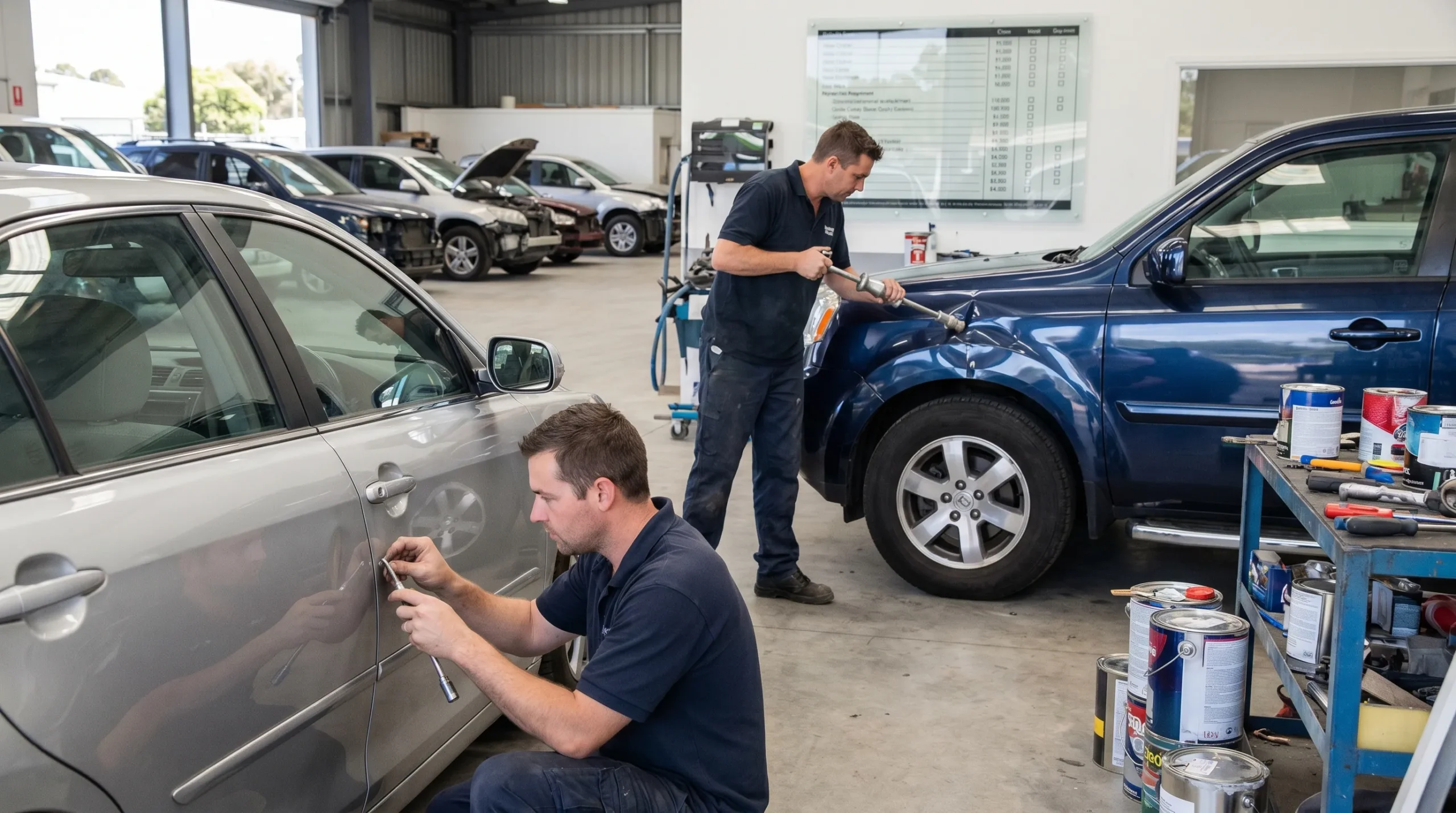
How much to fix a dent in a car depends on more than the dent itself. In real life, the final dent repair cost usually comes down to the size, depth, location, whether the paint is damaged, what material the panel is made from, and whether the job can be handled with paintless dent repair (PDR) or needs full body shop repair. Across the competitor data, small dents can start around $50 to $125, while deeper, awkward, or paint-damaged dents can quickly move into the hundreds or even low thousands.
The good news is that not every dent is expensive. A small, shallow door ding with no paint damage may be a fast PDR job. A dent on a bumper with sensors, over multiple panels, or in high-strength steel or aluminum panels will usually cost more. That is why two dents that look similar at first glance can have very different repair quotes.
This guide breaks down average auto dent repair cost, PDR vs traditional repair, DIY vs professional dent repair, insurance, hail damage, and how to get a fair quote without overpaying.
Quick Answer: How Much Does It Cost to Fix a Dent in a Car?
If you want the fastest answer, most sources agree on a broad starting range: professional dent repair can run from about $50 to $2,500, depending on severity and repair method. Chase says small dents around an inch in size may cost roughly $50 to $125, while dents from a collision often start at $150 or more. Jerry gives a similar range, saying dent repair can fall between $50 and $2,500, with small shallow dents around $125 and larger dents costing more.
For paintless dent repair, Synchrony gives a practical breakdown: small, light dents often run $50–$100, medium dents about $75–$300, and large dents around $300–$500. DingGo adds that PDR often averages $150 to $250 per damaged panel, but a harder impact point or tricky location can push a PDR job to around $450.
Here is a simple rule of thumb:
| Repair scenario | Typical range |
|---|---|
| Very small shallow dent / door ding | $50–$125 |
| Small to medium PDR-eligible dent | $75–$300 |
| Larger dent, still PDR-friendly | $300–$500 |
| Dent needing paintwork or filler | $200–$800+ |
| Multi-panel or major body-shop repair | $900–$2,500+ |
| Severe hail / many panels | Up to $15,000 |
Those numbers vary by shop and region, but they match the patterns across the pages you provided.
Dent Repair Cost Breakdown by Dent Size and Severity
The first thing any technician looks at is the dent’s size and depth. A shallow dent is generally cheaper because the metal has not been stretched as aggressively and the panel shape is easier to restore. A deep dent, sharp dent, or crease dent usually costs more because it takes more time, more skill, and sometimes more than one repair method. Chase and Jerry both note that shallow repairs are cheaper than medium or deep ones, while Synchrony separates dents into round, sharp, crease, and more serious damage categories.
A dent that is roughly an inch in size and has intact paint is often the sweet spot for lower-cost repair. Once the dent gets larger, folds on a body line, or sits on an edge of the panel, the quote usually climbs. That is especially true if the dent is no longer just cosmetic and starts affecting nearby trim, seams, or other parts of the body panel.
This is also why searchers looking up how much does a small dent cost to fix often get a deceptively wide range. “Small” does not always mean “easy.” A small dent in the middle of a flat door skin is one thing. A small dent near a bumper sensor, wheel arch, or door edge can be more labor-intensive.
What Affects the Cost of Dent Repair?
The main factors that influence the cost for dent removal are surprisingly consistent across competitors. The first is dent location. Hard-to-reach dents cost more, especially if technicians need to remove trim, access the back side of the panel, or work around electronics or braces. Chase specifically notes that high-strength steel materials or repairs requiring removal of multiple parts can increase cost. Jerry says dents over multiple panels or near sensors can push the price up significantly.
The second factor is the panel material. Modern cars increasingly use high-strength steel, aluminum panels, and mixed-material construction. These materials can be harder to manipulate and may limit whether paintless dent repair is possible. That does not always make repair impossible, but it often changes the labor time and technique.
The third factor is the shop itself. Chase points out that dealerships often charge more than independent body shops, and costs vary by city, state, local competition, parts availability, and hourly labor rates. Jerry adds that make and model matter too, with luxury vehicles typically costing more to repair than budget cars.
The last big factor is paint condition. If the paint is intact, the dent might qualify for PDR. If the paint is cracked, chipped, or stretched, the repair can shift into body filler, primer, sanding, repainting, and sometimes panel blending. That change alone can move the cost from a quick low-hundreds repair to a much larger body shop repair cost.
Paintless Dent Repair vs Traditional Body Shop Repair
For most readers, the real money question is not just dent repair cost. It is whether the dent can be fixed with paintless dent repair or whether a full auto body shop dent repair is necessary.
PDR is usually the cheapest professional option when the dent is localised, the metal is not too badly stretched, and the factory paint is still intact. Synchrony describes PDR as an affordable, convenient method that technicians often complete in under two hours, especially for dents without paint damage. DingGo also frames Paintless Dent Removal as the most efficient and cost-effective choice when the dent is not too deep and does not require a new paint job.
Traditional body shop repair becomes more likely when the dent is very large, very deep, sharply creased, or involves paint damage. Synchrony says once paint damage is involved, an auto body shop may need to repair the dent and repaint the area, and those repairs can easily reach $2,000 or more.
A simple way to think about it is this:
PDR is best for small to medium dents with intact paint.
Traditional repair is more likely when there is paint damage, filler work, heavy deformation, or structural concern.
When PDR Is Usually the Cheapest Option
If the dent is small, visible from one angle, not too deep, and the paint has not cracked, PDR pricing is usually the best value. Synchrony’s range of $50–$100 for small dents and $75–$300 for medium dents fits this type of case, while DingGo’s $150 to $250 per damaged panel is a useful panel-based benchmark.
The biggest advantage is not just price. PDR keeps the original finish intact, avoids repainting, and is often faster. That makes it attractive for owners who care about resale value, trade-in value, or simply want the repair done quickly.
When You’ll Need Filler, Sanding, or Repainting
When the paint is damaged or the dent shape cannot be fully restored, the repair may require body filler. Synchrony explains that Bondo®, sanding with 80 grit sandpaper, glaze and spot putty, primer, and a paint repair kit may all be part of the process. That is a strong sign the job has moved out of simple paintless dent removal territory.
Once repainting enters the picture, cost rises for two reasons: more labor and more finishing work. You are no longer just removing a dent; you are restoring surface appearance, matching paint, and sometimes blending surrounding panels. DingGo’s examples show that a dent requiring painting and surrounding panel blending can cost $450 to $800.
Cost by Dent Type and Location
Not all dents are equal, and this is where readers often need the clearest guidance. A door ding repair cost is usually lower than a bumper dent repair cost, and a multi-panel dent is often more expensive than either.
| Dent type / location | Typical range from competitor data |
|---|---|
| Small door dent / ding | $50–$125 or $200–$400 if more significant |
| Small to medium PDR dent | $75–$300 |
| Larger PDR dent | $300–$500 |
| Painted door dent with blending | $450–$800 |
| Rear + trunk damage | $500–$800 |
| Guard, bumper, bonnet, multi-panel damage | $900–$1700 |
Chase and Jerry support the low end for very small dents, while DingGo gives more detailed examples for car door, trunk door, and multiple panels.
A bumper dent repair cost can be higher than people expect because bumpers may contain sensors and can be harder to repair neatly. Jerry specifically notes that dent cost rises significantly when the dent is in an area with sensors, like a bumper.
A dent that reaches across the guard, bumper, and bonnet, or affects the rear and trunk door, typically becomes a larger job because more than one panel or section of the car must be corrected. That is why multi-panel damage often lands in the high hundreds or low thousands even when it does not look catastrophic at first.
How Much Does Hail Damage Cost to Repair?
Hail damage repair cost is its own category because it often involves not one dent, but dozens. DingGo says a small hail dent may cost as little as $80 to $200, but if multiple panels are affected, the total can reach up to $15,000, with the car potentially off the road for a few weeks rather than a few hours.
That is why insurance becomes much more relevant for hail than for a single minor dent. Even if PDR is still the right method, the sheer number of impact points changes the math completely.
DIY Dent Repair vs Professional Repair: What Actually Saves Money?
DIY dent removal cost looks attractive at first. Chase says a simple dent puller can start at around $4, while larger PDR kits can go as high as $800. The average versatile kit is around $50, and touch-up paint kits can run $5 to $70. Jerry echoes the same idea, noting that DIY tools start around $4 and paint touch-up can add up fast.
But low tool cost does not always mean low total cost. Both Chase and Jerry warn that a bad DIY attempt can worsen the damage and lead to a more expensive professional repair later. That is especially true if you crack the paint, distort the panel more, or create a repair that now needs filler, sanding, and paint correction.
A good real-world guideline is simple. If the dent is tiny, shallow, and you genuinely know what you are doing, DIY may be worth testing. If you are unsure, or the dent sits on a body line, near trim, or in a visible area you care about, professional dent repair is usually the smarter financial move. In other words, professional versus DIY dent repair costs should be judged by outcome, not just by tool price.
Is It Worth Fixing a Small Dent?
In many cases, yes. Chase says small dents may cost $100 or less to fix, and Jerry says fixing a small dent for around $125 can be worthwhile, especially if you plan to sell or trade in the car. Both also note that dents can reduce resale value and create buyer concern about hidden damage.
Even when the dent seems cosmetic, leaving it alone can create other problems. Chase warns that poor repair or paint issues can contribute to rust, while Jerry notes that visible dents can make the car’s body deteriorate faster than expected. A clean repair can protect appearance, help preserve value, and make the car easier to sell privately.
If you are preparing for a private sale, trade-in, or even a lease return, a cheap dent repair often makes sense because shoppers and dealers notice visible flaws immediately. A small fee up front may protect a larger amount of perceived value later.
Will Insurance Cover Dent Repair?
Does insurance cover the cost for dent repair? Sometimes, yes. Jerry says coverage may apply depending on the cause of the dent and your policy. Damage from another person, a collision with a vehicle, the elements of nature, or a collision with an animal may be covered.
But coverage does not always mean you should file a claim. Jerry also says it is usually not worth filing for minor dents unless the damage exceeds your deductible, because a small repair may only cost a couple hundred dollars. For single dents, paying out of pocket is often the cleaner option. For severe hail damage or multi-panel damage, insurance becomes much more practical.
So the smart question is not just does insurance pay for dent repair. It is whether the claim makes financial sense after you compare the repair quote with your deductible and potential rate impact.
How Long Does Dent Repair Take?
Time matters almost as much as price. Synchrony says PDR technicians can often complete repairs in under two hours, and may even come to you. DingGo contrasts severe hail cases by saying a car can be off-road for a few weeks rather than a few hours when multiple panels are damaged.
That difference is a major reason mobile dent repair and mobile paintless dent repair have strong search value. For a localised dent with intact paint, speed and convenience are major selling points. For paint-damaged or multi-panel repairs, traditional shop time is usually longer because the workflow includes prep, repair, paint, drying, and finishing.
How to Get an Accurate Dent Repair Estimate Without Overpaying
One of the best pieces of advice from the competitor set is also one of the simplest: get more than one quote. Chase recommends getting a few bids from local collision centers or auto body shops, and Synchrony says to call 2–3 professionals to compare price and turnaround time.
When asking for a quote, do not just ask, “How much?” Ask whether the dent qualifies for PDR, whether paintwork is included, whether surrounding panels need blending, whether bumper sensors or trim removal add cost, and whether replacing the panel would be cheaper if the estimate gets too high. Synchrony even notes that if a repair is $1,000 or more, it may be worth asking whether replacing the panel is more affordable.
A smart estimate checklist includes photos, your VIN if the shop uses an estimator, and clear information about dent size, location, and paint condition. That makes it much easier to compare quotes fairly.
FAQ: Common Questions About Dent Repair Cost
Can a small dent be fixed without repainting?
Yes, often. If the paint is intact and the dent is localised, paintless dent repair may work.
Is PDR cheaper than traditional dent repair?
Usually, yes. The competitor data consistently shows PDR on the lower end, while paint-damaged body-shop repairs can become much more expensive.
Does bumper dent repair cost more?
It can. Bumper sensors and awkward access can raise price significantly.
Can I estimate my dent repair cost at home?
Only roughly. Jerry says you can get a ballpark estimate by looking at location, size, depth, make and model, and local repair averages, but a shop will price it more accurately.
Should I fix a dent before selling my car?
Usually yes for small, visible dents. Chase and Jerry both connect dent repair with better trade-in and private sale outcomes.
Final Words
The best answer to how much to fix a dent in a car is this: expect anywhere from about $50 for a tiny simple dent to $2,500 or more for complex body-shop work, with PDR often falling in the most affordable middle ground when the paint is still intact. A small shallow dent is usually cheap. A dent with paint damage, multiple panels, sensors, or deeper deformation gets expensive fast.
Disclaimer:
This article is for general informational purposes only. It explains typical dent repair costs, methods, and timelines, which can vary by dent size, location, vehicle type, and repair method. Readers should consult a qualified technician for accurate estimates.