

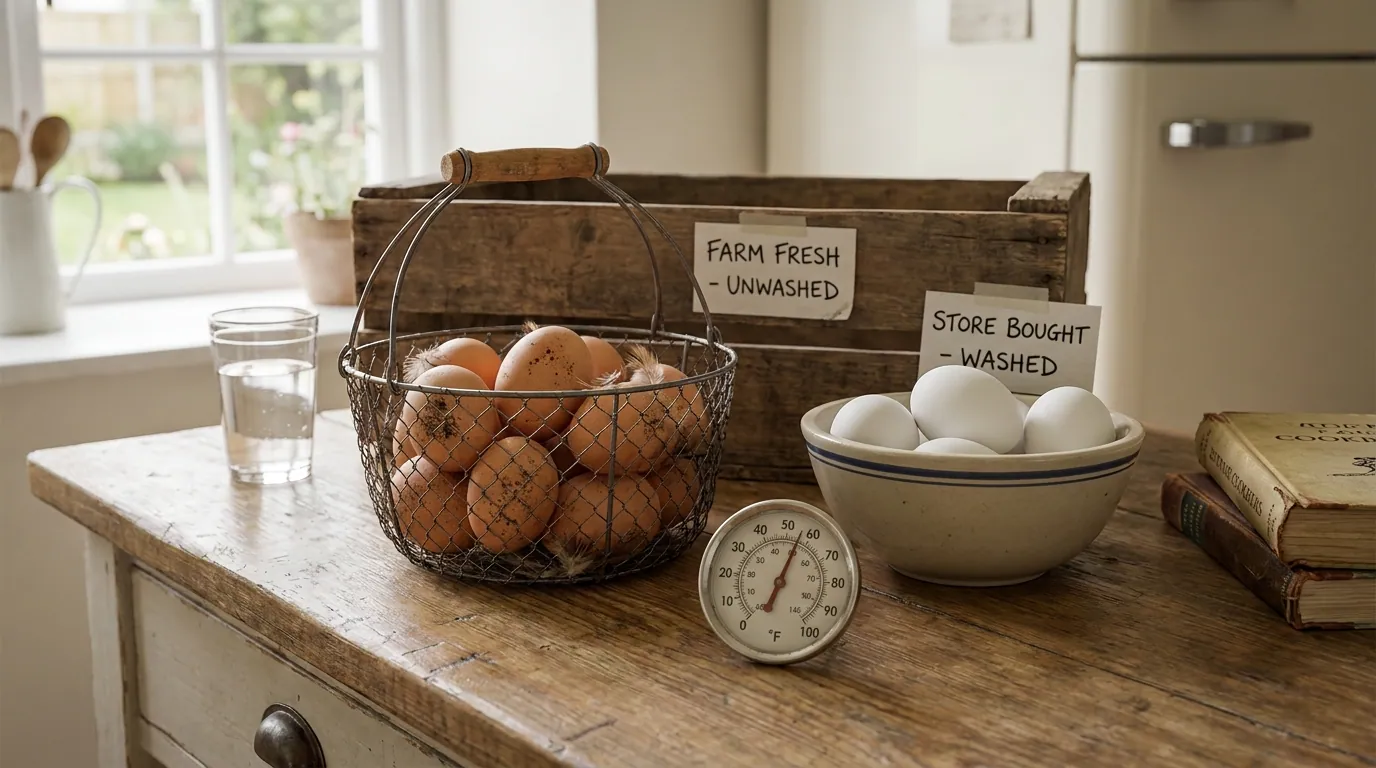
How long do fresh eggs last on the counter depends mainly on whether the eggs are unwashed farm-fresh eggs, washed eggs, or already refrigerated store-bought eggs. In practical terms, unwashed farm fresh eggs with the bloom or protective cuticle still intact can often keep at room temperature for around 2 to 3 weeks, sometimes longer in cool, stable conditions. But store-bought eggs in the United States should generally not stay out for more than 2 hours, or 1 hour if the temperature is above 90°F, because they have already been washed and refrigerated. Once eggs are cold, they should stay cold.
That difference is why so many people get confused. One article says eggs can stay on the countertop for weeks, while another says to toss them after a couple of hours. Both can be right, but they are talking about different kinds of eggs. If you understand washed vs unwashed eggs, egg bloom, food safety, and Salmonella risk, the answer becomes much easier.
Quick Answer: It Depends on the Type of Egg
If you have freshly laid eggs from a backyard flock or local farm and they are unwashed eggs, they still have a natural coating called the bloom. That coating helps seal the shell pores and slows down bacteria and moisture movement. That is why many people safely store fresh eggs at room temperature for a limited time. Extension-style guidance and common farm practice often place that window around 2 to 3 weeks on the counter, with longer life in the refrigerator.
If you have washed eggs or store-bought eggs, the rules change. In the U.S., commercial shell eggs are washed and then kept refrigerated. The FDA says eggs should be stored at 40 degrees Fahrenheit or below, and refrigerated eggs should not be left out too long because bacteria that cause illness grow quickly between 40°F and 140°F.
So the short version is this:
| Egg Type | Counter Storage | Best Practice |
| Unwashed farm fresh eggs | About 2 to 3 weeks in cool conditions | Keep dry, unwashed, and away from heat |
| Washed farm fresh eggs | Not ideal for long counter storage | Refrigerate after washing |
| Store-bought refrigerated eggs | No more than 2 hours | Return to fridge quickly |
| Any eggs above 90°F | About 1 hour max | Discard if left out too long |
How Long Do Unwashed Farm Fresh Eggs Last on the Counter?
For most people asking how long do farm fresh eggs last, this is the real question. Unwashed eggs can usually stay on the counter for 2 to 3 weeks without much trouble if your kitchen is reasonably cool and dry. Some homesteaders stretch that to up to 30 days, but quality drops over time, and warmer conditions shorten the safe window.
The reason is the bloom, also called the cuticle. This natural layer acts like a seal over the egg’s porous shell. When it stays intact, it slows dehydration, reduces moisture loss, and helps keep outside contamination from moving inward. That is why farm fresh eggs are different from supermarket eggs.
Still, “last” can mean two different things. An egg may still be safe to eat, but no longer at peak quality. USDA agricultural research notes that eggs stored at room temperature lose quality faster, and even unwashed eggs can go from excellent texture to thinner whites and a larger air pocket in as little as a week. So when people ask how long do fresh eggs last unrefrigerated, the honest answer is that quality and safety are not the same thing.
A simple example helps. Imagine two eggs from the same backyard flock. One is kept in a cool pantry for 10 days. The other sits on a sunny kitchen counter during a hot afternoon every day. Both are technically “unwashed,” but the second one faces more temperature swings and higher spoilage risk. That is why room temperature egg storage by climate matters so much.
How Long Do Store-Bought or Refrigerated Eggs Last on the Counter?
This is where many articles bury the most important warning. If your eggs came from a grocery store in the U.S., they were almost certainly refrigerated already. Those eggs should not sit on the counter for hours at a time. The FDA and USDA guidance is straightforward: keep eggs refrigerated, and do not leave them out more than 2 hours, or more than 1 hour above 90°F.
That means the answer to how long can store-bought eggs sit out on the counter is not “a few days.” It is a short window. If you brought groceries home, got distracted, and the carton sat out for 90 minutes, that is usually still within guidance. If the eggs sat out all afternoon, or overnight, that is a different story.
Here is the key point: refrigerated eggs on the counter can develop condensation. A cold egg moved into a warm room may “sweat,” and that moisture can help bacteria move more easily across the shell. USDA agricultural guidance specifically warns that a cold egg left out at room temperature can sweat, increasing the potential movement and growth of bacteria.
So if you are searching how long can eggs sit out before going bad, the most accurate answer is:
- Unwashed farm eggs: often 2 to 3 weeks
- Washed or refrigerated eggs: about 2 hours
- Hot weather above 90°F: about 1 hour
That is the distinction most searchers actually need.
Why Washed and Unwashed Eggs Behave So Differently
The difference between washed eggs and unwashed eggs explains almost the entire topic.
When an egg is laid, it comes with a thin natural coating called the bloom. This layer helps block the shell’s pores and protects the inside from outside contamination. If you leave that coating alone, the egg can tolerate counter storage much better. If you wash the egg, you remove much of that natural defense.
That is why do farm eggs need refrigeration after washing usually gets a yes. Once washed, eggs should be treated more like store-bought eggs and placed in the refrigerator. That is also why does washing eggs remove the bloom is such an important long-tail topic: the answer changes how you store them.
This also clears up another common question: should eggs be washed before storing or before using? For many people with backyard hens, the better approach is to leave clean eggs unwashed until you are ready to use them. If an egg is visibly dirty, crack it into a separate bowl first and inspect it carefully, or wash it and then refrigerate it.
Why Eggs Are Refrigerated in the U.S. but Not in Some Other Countries
A lot of confusion comes from reading advice written for different food systems. In the United States, eggs are generally washed and sanitized as part of commercial processing, which removes the protective cuticle and makes refrigeration essential. In many European systems, eggs are not washed the same way, and producers rely more heavily on flock health controls and other safety measures, so room-temperature retail storage is more common.
That is why why are eggs refrigerated in the U.S. but not in Europe is one of the most important supporting questions. People are often comparing two correct answers from two very different systems.
So when you see someone say eggs stay fine on the counter for weeks, ask: Were those eggs washed? Were they ever refrigerated? What country are we talking about? Without that context, the advice sounds contradictory when it really is not.
Can Eggs Sit Out Overnight? Here’s When to Throw Them Away
This is one of the highest-intent questions in the whole topic cluster. Someone is not just curious. They want to know whether breakfast is ruined.
If the eggs were store-bought refrigerated eggs and they sat out overnight, the safest answer is usually throw them away. They were out much longer than the FDA’s 2-hour rule, and if the kitchen was warm, the risk rises even more.
If the eggs were unwashed farm fresh eggs that had never been refrigerated, the answer is different. In that case, overnight on the counter is usually normal. But you still want to think about heat, humidity, shell condition, and cleanliness. An intact, clean egg in a cool house is not the same as a dirty egg near a stove in summer.
This is also where people ask, can you refrigerate eggs again after leaving them out? If they were previously refrigerated and left out too long, putting them back in the fridge does not erase the time-temperature exposure. Refrigeration slows bacterial growth; it does not reverse what already happened.
What Happens When Cold Eggs Sweat on the Counter
One of the most overlooked issues in egg safety is eggs sweating after refrigeration. When a cold egg moves into warm air, moisture can collect on the shell. That condensation on eggs creates conditions that help bacteria move and grow more easily. USDA agricultural guidance directly mentions this effect.
That is why repeated trips from fridge to counter and back again are not a great habit. If you need room temperature eggs for baking, it is better to take them out shortly before use rather than leaving them out for half the day. For many recipes, about 30 minutes is enough to take the chill off without pushing into unsafe territory. This timing is an inference based on the 2-hour safety window and common baking practice, not a specific FDA rule.
How to Tell If Fresh Eggs Are Still Good
The best freshness test starts before the egg ever hits a bowl. Look for cracked eggs, leaks, slimy residue, or an unusual surface. If the shell looks damaged or dirty enough to make you uneasy, be cautious.
Next comes smell. A spoiled egg usually gives itself away with a strong sulfur or rotten egg smell as soon as you crack it. That is one of the most reliable signs that the egg has gone bad.
Then there is the famous egg float test. Yes, it can be useful, but it is often misunderstood. Eggs float as the air cell inside gets larger over time, which means the egg is older. It does not automatically mean the egg is unsafe. A floating egg should be cracked into a separate bowl and checked for odor and appearance before you decide. That makes float test myths worth addressing directly.
A simple check list looks like this:
| Sign | What It Suggests |
| Strong bad smell | Discard immediately |
| Cracked or leaking shell | Higher contamination risk |
| Slimy or powdery surface | Possible spoilage or bacterial growth |
| Egg sinks and lies flat | Usually very fresh |
| Egg stands up or floats | Older egg; inspect carefully |
Notice what is missing from that table: panic. A slightly older egg is not always a dangerous egg. But a bad smell or damaged shell is much harder to ignore safely.
Best Way to Store Fresh Eggs for Maximum Shelf Life
If your goal is maximum shelf life of eggs, the refrigerator wins. FDA and USDA guidance says eggs should be kept at 40°F or below, preferably in their original carton, and not in the fridge door, where temperatures swing more often. USDA agricultural guidance also says the coldest part of the refrigerator is better than the door.
For unwashed farm fresh eggs, counter storage can be convenient, but refrigeration still extends life substantially. Some extension-style guidance notes that unwashed in the refrigerator may last months, while washed in the refrigerator can still keep well, though quality gradually declines.
A practical storage chart helps:
| Storage Method | Typical Use Window | Notes |
| Unwashed on the counter | 2 to 3 weeks | Best in cool, dry conditions |
| Unwashed in the refrigerator | Up to several months | Better for longest storage |
| Washed in the refrigerator | Usually weeks to a couple of months | Keep consistently cold |
| Store-bought on the counter | 2 hours max | 1 hour above 90°F |
How Hot Weather, Humidity, and Kitchen Conditions Change the Answer
A cool farmhouse kitchen in spring is not the same as an apartment kitchen in peak summer. Heat matters. The FDA’s general guidance tightens from 2 hours to 1 hour when temperatures climb above 90°F. That is a huge detail for anyone dealing with summer egg storage, hot climates, or eggs left in a car.
Humidity also plays a role. Extension-style egg storage materials sometimes mention conditions such as 55 degrees Fahrenheit and 70 to 75% humidity for specialized storage, which shows just how much environment affects egg keeping. For normal home cooks, the takeaway is simpler: the warmer and more humid the space, the less reliable counter storage becomes.
So if you are in a hot climate and asking do fresh eggs need refrigeration in Pakistan or another warm region, the safest practical advice is to lean more heavily toward refrigeration, especially once eggs are washed or if indoor temperatures are high for long stretches. That is an inference from the official time-and-temperature guidance.
Should You Wash Fresh Eggs Before Storing or Before Using Them?
For many backyard chicken owners, the best answer is: only wash eggs when needed, and once washed, refrigerate them. If eggs are fairly clean, keeping the bloom intact gives them their best chance on the counter. If they are dirty, washing may be worth it, but it changes storage strategy.
Use clean running water if you must wash, dry the eggs, and place them in the fridge. Do not wash them and then leave them on the countertop as if nothing changed. That is where people shorten shelf life without realizing it.
This also helps answer do eggs spoil faster after washing. In practical home storage, yes, they usually lose their advantage because the natural protective layer is gone.
A Simple Real-Life Example
Imagine a small backyard flock with 19 hens producing eggs regularly. The clean, intact eggs collected daily can be kept unwashed for short room temperature storage if the house stays cool. But once a batch is washed for gifts, farmers market sales, or convenience, those eggs should head to the refrigerator. The egg did not become unsafe the moment you washed it, but you changed the rules.
That is the kind of practical distinction many articles miss, and it is exactly why users keep searching this topic.
Frequently Asked Questions
Can I use eggs for baking if they sat out for a little while?
Usually yes, if they were out for a short time and still within safe limits. For refrigerated eggs, that means staying well inside the 2-hour rule.
Should eggs be stored in the fridge door?
No. The coldest part of the refrigerator is better, and the fridge door gets more temperature swings.
Can unwashed eggs go in the fridge?
Yes. Refrigeration is fine and usually extends life. Just remember that once chilled, they should stay chilled.
Can you eat eggs that failed the float test?
Sometimes, yes. A float test shows age more than guaranteed spoilage. Crack the egg into a separate bowl and check smell and appearance.
Bottom Line
How long do fresh eggs last on the counter is really a question about handling history. Unwashed farm fresh eggs may last around 2 to 3 weeks on the counter in cool conditions because the bloom helps protect them. Washed eggs and store-bought refrigerated eggs should be treated much more carefully, and refrigerated eggs should not stay out more than 2 hours, or 1 hour above 90°F.
If you remember one thing, make it this: farm-fresh unwashed eggs and store-bought refrigerated eggs are not the same storage situation. Once you understand that, the conflicting advice online makes a lot more sense.