

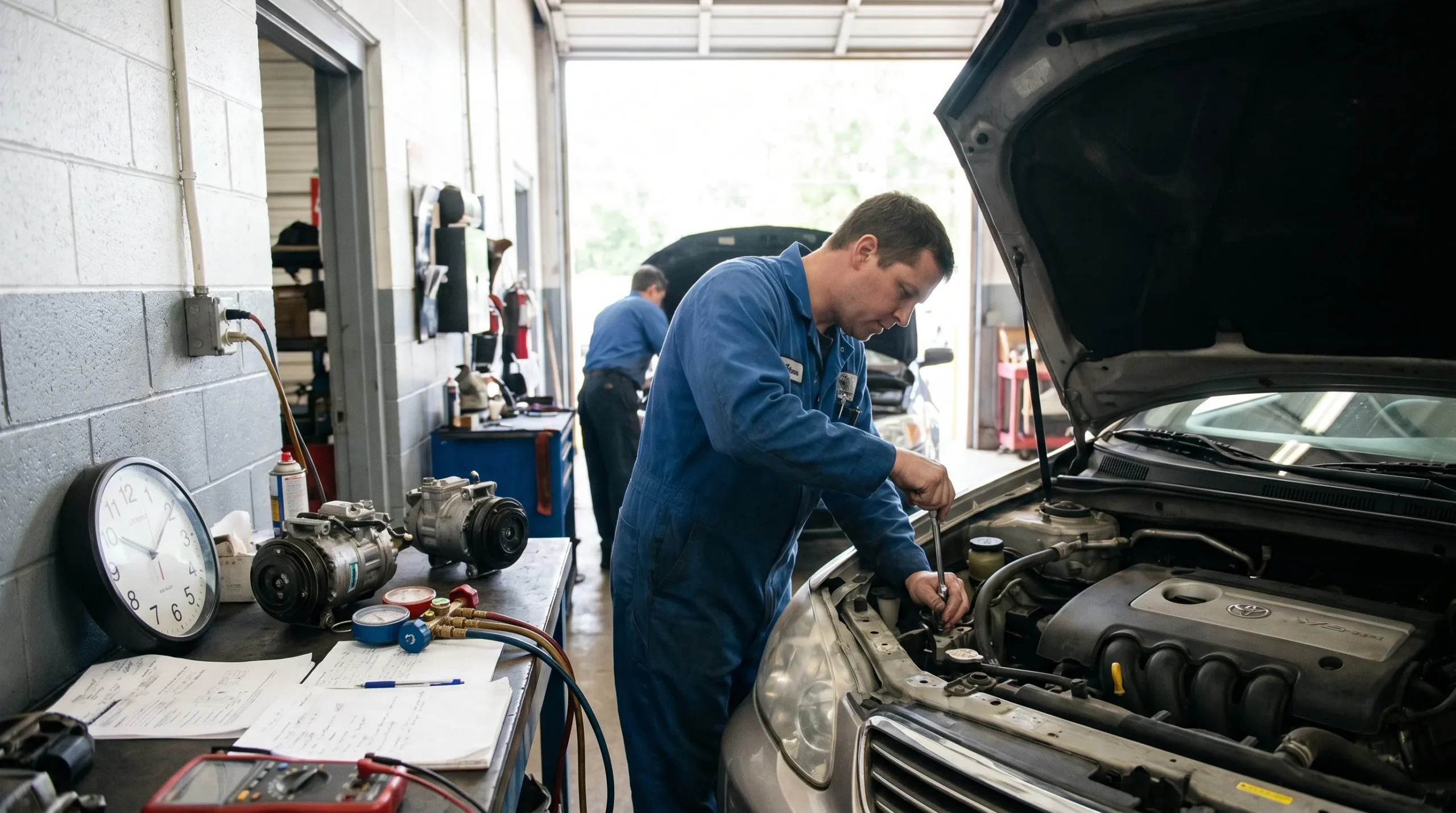
How long does it take to fix ac in car is one of those questions that sounds simple, but the honest answer depends on what is actually broken. In many cases, a minor car AC repair can be done in about 30 minutes to 3 hours, while a bigger repair like a compressor or evaporator core job can take half a day or more. Competitor pages cluster around similar ranges: Valvoline says a basic air conditioning service usually takes about 30 minutes, Master AutoTech says many fixes take 1 to 3 hours, and Urbs Garage says simple jobs may take 1 to 2 hours while complex ones can stretch much longer.
That means the real question is not just “how long does car AC repair take?” but “what kind of AC problem does the car have?” A quick refrigerant recharge is very different from a hidden refrigerant leak, a failed blower motor, a bad compressor clutch, or a system issue buried behind the dashboard. This article breaks down the likely timeline by repair type, explains what happens during car AC diagnosis, and shows what can turn a same-day fix into a longer shop visit.
The short answer: most car AC repairs are same-day, but not all
For most drivers, a realistic expectation is this: a simple AC recharge or basic air conditioning service may take around 30–60 minutes to 1–2 hours, a moderate repair often falls in the 1–3 hour range, and a major repair can take 3 to 6 hours or more. Master AutoTech puts simple recharge work at roughly 30–60 minutes, minor leak or part replacement at around 1–2 hours, and bigger jobs like compressor or evaporator replacement at several hours or longer. At Home Auto Care gives a total mobile repair estimate of 45–120 minutes for many common cases.
A good way to think about car AC repair time is that the clock usually has three parts: diagnosis, repair, and final testing. If all three go smoothly and the part is easy to access, you may get your car back the same day. If the technician has to chase a hidden leak, order parts, or open up a section of the dash to reach the evaporator core, the repair can take much longer.
How long does it take to fix car AC by problem type?
The clearest way to answer “how long does it take to fix AC in a car?” is to match the time to the problem.
| AC issue | Likely fix | Typical repair time |
|---|---|---|
| Low refrigerant only | Refrigerant recharge / A/C system recharge | 30 minutes to 2 hours |
| Small leak or minor part | Replace hose, seal, sensor, or valve and retest | 1 to 2 hours |
| Blower motor problem | Replace blower motor | 2 to 3 hours |
| Compressor problem | Replace compressor or compressor clutch | 4+ hours |
| Evaporator core issue | Dash access, replace evaporator core, recharge | Several hours to half a day or more |
| Electrical issue | Test fuses, relays, wiring, controls | Varies from under 1 hour to several hours |
| Hidden leak / repeat low cooling | Leak detection with UV dye, sniffer, pressure tests | Often adds extra time |
These ranges line up closely with the current competitor set. Valvoline says basic service is around 30 minutes. Master AutoTech says common fixes often take 1 to 3 hours, with recharges at 30–60 minutes and more involved jobs taking longer. Urbs Garage says refrigerant recharge usually takes 1–2 hours, blower motor replacement takes 2–3 hours, and more complex repairs like compressor replacement may take 4–6 hours.
The important takeaway is that repair timeline by component matters more than the word repair itself. A recharge-only visit is one thing. A failing condenser, an evaporator leak, or a seized compressor is something else entirely.
What happens during a car AC diagnosis and repair visit?
A professional car AC diagnosis usually starts with an initial inspection and diagnosis. The technician checks your complaint, tests system pressures, looks at cooling performance, and decides whether the issue is low refrigerant, a leak, a mechanical failure, or an electrical problem. At Home Auto Care breaks the process into steps like inspection, leak testing, repair, and system testing / performance verification. Master AutoTech lists tasks such as removing leftover refrigerant safely, inspecting the evaporator core, replacing damaged parts, checking electrical components like relays, fuses, and control modules, cleaning vents, and recharging the system.
That means a true AC repair visit is often more than “just adding refrigerant.” In a proper service flow, a shop may use gauges, pressure tests, UV dye, or an electronic sniffer to find a leak, then recover the refrigerant, replace the failed part, evacuate the system, recharge it with the correct type and amount, and verify vent temperature consistency and compressor engagement under load. Meineke specifically mentions black light-enabled dyes and a sniffer as leak-detection methods.
This is one reason repair time can vary so much. A problem that looks like warm air from the vents might turn out to be a simple cabin filter issue, but it could also be a clogged expansion valve, faulty compressor clutch, blown fuse, or leak inside the A/C system. Meineke explicitly lists those as possible causes of warm air.
What affects how long it takes to fix AC in a car?
The biggest factor is what failed. A refrigerant recharge with no leak found is usually much faster than a repair that requires removing parts, opening the dash, or tracing a slow refrigerant leak. Master AutoTech says some repairs are quick and straightforward, while others need more time, diagnostics, and parts.
The second big factor is vehicle make and model. Some cars make it easy to access the compressor, blower motor, or condenser. Others bury important components behind tight engine-bay packaging or behind the dash. That is why two vehicles with what sounds like the same symptom can have very different labor costs and repair timelines. Master AutoTech and Urbs Garage both point to vehicle make and model as a real variable.
The third factor is parts availability. Even if diagnosis only takes 15–30 minutes, the repair may stall if the correct compressor, O-rings, hose, or receiver-drier is not in stock. Master AutoTech specifically notes that larger repairs can take longer if parts need to be ordered, and that can turn a same-day repair into a next-day or multi-day job.
A fourth factor is seasonality. As temperatures rise, shops get busier with cooling complaints, and drivers become much less willing to wait when the AC fails. NHTSA says that as temperatures rise, your A/C works harder and recommends checking A/C performance and the cabin air filter before travel.
Common car AC problems and how each one changes the timeline
A lot of searchers do not know whether they need a recharge, a repair, or a full component replacement. Here is the simple version.
If the system is just low on refrigerant, the solution may be a refrigerant recharge, and that is often the quickest outcome. But if the refrigerant is low because of a leak, the recharge alone does not truly solve the problem. Urbs Garage notes that low refrigerant can make the system blow warm air, and Meineke explains that hoses and seals can lose elasticity over time, allowing refrigerant to escape while moisture enters the system.
If the issue is a blower motor, the airflow may be weak or absent even when the system is technically cooling. Urbs Garage says replacing a blower motor can take around 2–3 hours.
If the problem is a compressor or compressor clutch, the timeline usually moves into the longer category. These failures often require more labor, more parts, and a full evac-and-recharge procedure after replacement. That is why many articles put compressor replacement in the 4+ hour range.
If you notice bad smells from the vents, do not assume it is only cosmetic. Meineke says odors can come from an old or dirty cabin filter or from an evaporator case that has developed mold. That kind of problem may not require the same repair path as a refrigerant leak, but it still affects how long the service takes.
AC recharge vs AC repair: they are not the same thing
This is where many articles stay too shallow. A car AC recharge is a type of service. A true car AC repair means something failed and needs to be diagnosed and fixed.
A recharge may restore cooling if the refrigerant level is low and no leak is present. That is why Valvoline can say a basic air conditioning service usually takes about 30 minutes. But a recharge is not the same as fixing a cracked hose, a leaking seal, a failed condenser, or a bad compressor.
That distinction matters because modern automotive AC systems are closed systems. In plain English, they are not supposed to “use up” refrigerant like fuel. If the charge is low, there is often an underlying reason. RepairPal also warns that the system is not serviceable without proper recovery and evacuation equipment, and that releasing refrigerant is unsafe and not a DIY job.
So if you are asking “how long does it take to fix car AC?”, make sure you are not really asking “how long does it take to recharge car AC?” Those are related, but they are not the same question.
Can car AC be fixed the same day?
Often, yes. Same-day AC repair is realistic when the issue is a simple recharge, a minor leak, a small part replacement, or a straightforward electrical fix. At Home Auto Care says many mobile AC repairs are finished in 45–120 minutes, and Master AutoTech says many common repairs fall into the 1 to 3 hour range.
But same-day does not mean guaranteed. If the shop needs to order a part, diagnose an intermittent problem, or access something behind the dash, the car may stay longer. A good rule is this: if the repair involves only testing, recharging, or an easy-to-reach part, it has a strong chance of being done the same day. If it involves a compressor, evaporator core, or a hidden leak, plan for more time.
How much does it cost to diagnose or fix car AC?
Time and cost usually move together. The longer the labor and the more parts involved, the more expensive the repair becomes.
A useful benchmark comes from RepairPal, which says the average cost for an AC diagnosis is between $122 and $179, with labor in that same range before taxes, fees, and related repairs. That number does not cover the full repair; it covers the diagnostic step that tells you what is actually wrong.
That is important because a driver might come in expecting a cheap refrigerant recharge, then find out the real issue is a leaking hose, corroded seal, or failing compressor. Urbs Garage gives a very wide example range of around $150 to $1,500 depending on severity, with compressor replacement potentially going over $1,000. Treat those numbers as broad market examples, not a fixed quote, because actual pricing depends heavily on the vehicle, parts, and labor rates.
Refrigerant type matters: R-134a vs R-1234yf
One content gap most competitors ignore is refrigerant type. This matters because it can affect service procedure, shop equipment, and sometimes repair time.
The EPA states that its rule adopted technical standards for equipment that recovers, recycles, and/or recharges R-1234yf in motor vehicle air conditioners, also called MVAC systems. In practice, that means newer vehicles using R-1234yf may require specific equipment and trained handling.
This does not automatically mean the job will take dramatically longer, but it helps explain why some shops can service one vehicle immediately while another needs a more specialized setup. It is also another reason DIY recharge kits can create problems when the wrong refrigerant or wrong procedure is used.
Why summer and hot climates make this topic more urgent
Car AC problems always feel worse in hot weather, but there is also a practical reason search interest spikes in spring and summer. NHTSA says that as temperatures rise, your A/C works harder, and that drivers should check A/C performance and the cabin air filter before traveling. NHTSA also says that lack of air conditioning on a hot summer day affects everyone, especially children and older adults who are sensitive to heat or in poor health.
That means seasonal demand can affect repair time in two ways: first, more systems fail or feel weak when they are under heavier load; second, more people rush to shops at the same time. So even if the actual labor is only 1–2 hours, the real-world wait for an appointment may be longer during a heat wave.
How to speed up your AC repair and avoid a longer visit
There are a few simple ways to keep car AC repair time closer to the shorter end.
First, do not ignore early signs like warm air, weak airflow, or strange smells. Master AutoTech says bringing the vehicle in as soon as something feels off makes it more likely to be a quick fix.
Second, describe the symptoms clearly. Tell the shop whether the air is warm all the time, only at idle, only on very hot days, or whether the airflow is weak but cold. That helps narrow the likely issue before the technician starts.
Third, ask whether the likely part is in stock. A repair that should take 2 hours can turn into tomorrow if a compressor, hose, or condenser has to be ordered.
Fourth, skip the temptation to keep topping off refrigerant at home. RepairPal warns that refrigerant can cause severe chemical burns if improperly handled and says A/C component repair is not considered a DIY job.
A quick real-world example
Imagine two drivers show up on the same day with the same complaint: “my car AC is blowing warm air.”
Driver A has a small refrigerant loss and no major leak. The technician runs a quick diagnostic check, confirms pressures, recharges the system, and verifies cooling. That visit may fall close to the 30 minutes to 2 hours range.
Driver B has the same warm-air symptom, but the real issue is a failing compressor clutch and moisture-contaminated refrigerant from a leak. Now the technician has to diagnose the fault, recover refrigerant, replace parts, evacuate the system, recharge it correctly, and retest it. That can move the job into the 4+ hour category or longer. Meineke specifically notes that warm air can be caused by a clogged expansion valve, faulty compressor clutch, blown fuse, or leaks within the A/C.
The lesson is simple: the symptom is not the timeline. The real cause is.
FAQs
How long does a car AC recharge take?
A basic A/C recharge can take around 30 minutes at a quick-service shop, though some sources place it closer to 1–2 hours once inspection and testing are included.
How long does it take to replace a compressor?
A compressor replacement is usually one of the longer jobs. Many shops treat it as a 4+ hour repair, especially if extra diagnosis or system cleanup is needed.
Can a bad cabin air filter make my AC seem broken?
Yes. A clogged cabin air filter can reduce airflow and make the A/C feel weak even if the refrigerant side is fine. NHTSA specifically recommends checking the cabin air filter before summer travel, and Meineke ties bad odors to old air in the cabin filter.
Why is my car AC blowing warm air after a recharge?
Because the low refrigerant may have been a symptom, not the root cause. A leak, compressor clutch, expansion valve, or electrical issue may still be present.
Is it safe to diagnose or recharge car AC yourself?
It is not a good idea. RepairPal says the system is not serviceable without proper recovery and evacuation equipment, and refrigerant mishandling can cause severe chemical burns.
Conclusion
So, how long does it take to fix ac in car? For many drivers, the realistic answer is about 30 minutes to 3 hours for a minor issue, with larger repairs taking several hours or even half a day or more. A fast air conditioning service or refrigerant recharge is at the short end. A compressor, evaporator core, hidden refrigerant leak, or hard-to-access component pushes the repair toward the long end.
The smartest approach is to treat warm air, weak airflow, bad smells, and repeat cooling loss as early warning signs. The sooner a qualified shop performs a real car AC diagnosis, the better your chance of getting a same-day repair instead of a longer, more expensive job.
Disclaimer:
This article is for general informational purposes only. It explains typical timelines and procedures for car AC repairs, which can vary by issue, vehicle, and parts availability. Readers should consult a qualified technician before taking action.