

Introduction
The dielectric strength of transformer oil need to check because this single test can reveal whether the oil is still able to protect a transformer from electrical breakdown, moisture-related failure, and premature insulation damage. In proper technical English, the query is usually expressed as “why the dielectric strength of transformer oil needs to be checked” or “why transformer oil dielectric strength should be tested.” The meaning, however, is the same: people want to know what dielectric strength is, how it is measured, what low results mean, and what action should be taken next.
In simple terms, dielectric strength of transformer oil refers to the oil’s ability to resist voltage without failing. The most common way to assess it is through a BDV test—short for breakdown voltage test—where voltage is increased across a controlled oil sample until breakdown occurs. A poor result often points to moisture, particles, aging by-products, or other contamination that weakens the oil’s insulating performance. Competitor content consistently clusters around this practical maintenance question, especially the relationship between BDV, contamination, filtration, and transformer reliability.
A strong article on this topic cannot stop at definitions. It needs to explain why testing matters, how the test works, what a good value looks like, why BDV alone is not enough, and when to filter, regenerate, retest, or replace the oil. That deeper approach is what makes the article genuinely useful for engineers, maintenance teams, plant operators, and buyers evaluating transformer oil condition.
What Is the Dielectric Strength of Transformer Oil?
Dielectric strength of transformer oil is the oil’s ability to withstand electrical stress without allowing current to arc through it. Since transformer oil acts as both a cooling medium and an insulating oil, its condition directly affects how safely the transformer can operate. When the oil is clean and dry, it provides a stronger insulating barrier. When it contains water, air bubbles, mechanical impurities, sludge, or acids, that barrier weakens.
This is why the term breakdown voltage of transformer oil is so important. It describes the voltage level at which the sample fails under test conditions. Some competitor content mentions practical thresholds such as 30 kV, while others reference higher-performance figures like 50 kV/mm or 750 kV/in in broader insulation discussions. Those numbers can be useful, but they should never be treated as universal pass/fail values without knowing the test method, electrode gap, and whether the oil is new, in service, or reconditioned.
Think of dielectric strength as a quick window into the oil’s immediate insulating condition. It does not tell the whole story by itself, but it does answer a very practical question: Can this oil still resist breakdown under controlled voltage stress?
Practical takeaway: A higher transformer oil dielectric strength generally means the oil is cleaner and drier, while a low result often suggests contamination or aging that deserves further attention.
Why Transformer Oil Dielectric Strength Needs to Be Checked
There are several reasons why the dielectric strength of transformer oil needs to be checked, and all of them lead back to one goal: preventing transformer failure before it becomes expensive or dangerous.
First, the test helps identify moisture contamination. Water is one of the most common causes of reduced insulating performance in transformer oil. Even when the oil still looks visually acceptable, moisture can lower its ability to resist electrical breakdown. Second, the test can reveal the impact of particles, fibers, oxidation products, and aging by-products that build up over time. Third, routine testing supports a broader preventive maintenance strategy by showing whether the oil is stable, deteriorating, or needs additional analysis.
This is especially important in power transformers, high-voltage transformers, and systems operating under thermal stress. In those environments, weak oil insulation can raise the risk of flashover, internal damage, and shorter service life. Some maintenance guidance also connects oil condition with acid buildup benchmarks such as 0.08 acid number, which matters because chemical aging can damage both the oil and solid insulation over time.
So, when someone asks why transformer oil dielectric strength should be checked, the real answer is this: it is one of the fastest ways to detect whether the oil is still fit to protect the transformer, or whether deeper condition assessment is now necessary.
What Low Dielectric Strength Usually Indicates
A low result in a transformer oil dielectric strength test does not happen randomly. It usually points to one or more underlying problems.
Moisture and Water Contamination
The most common cause is moisture in transformer oil. Water significantly reduces the oil’s insulating ability, making breakdown more likely under voltage stress. Humid storage conditions, poor sealing, aging insulation paper, or contaminated sampling can all introduce moisture into the oil. Competitor content repeatedly highlights water as one of the first suspects when BDV drops.
Dirt, Fibers, and Conductive Particles
Another major cause is transformer oil contamination from particles, dust, fibers, mechanical impurities, or conductive debris. These foreign materials create weak points in the sample, making it easier for the oil to fail during testing. Even small contamination can distort a breakdown voltage reading.
Oxidation, Acids, and Aging By-Products
As oil ages, it can form sludge, acids, and other aging by-products. These substances reduce the oil’s performance and may also signal deeper insulation stress. Some pages connect rising chemical degradation with operational temperature effects, including references such as 50°C test-related behavior and low-temperature properties like -45°C pour point discussions. Those figures do not directly define BDV quality, but they show how oil condition is tied to broader performance characteristics.
A Low Result Does Not Always Mean the Oil Must Be Replaced
This is where many articles stay too shallow. A low BDV of transformer oil does not automatically mean full replacement is necessary. In many cases, the oil may respond well to filtration, vacuum dehydration, or regeneration, especially if the issue is removable contamination rather than severe chemical aging. That decision should be based on the test result plus other diagnostics, not on BDV alone.
How the Dielectric Strength of Transformer Oil Is Tested
Among all competitor pages, this is the most heavily shared topic, and for good reason. Users do not just want a definition. They want to know how dielectric strength of transformer oil is tested in real life.
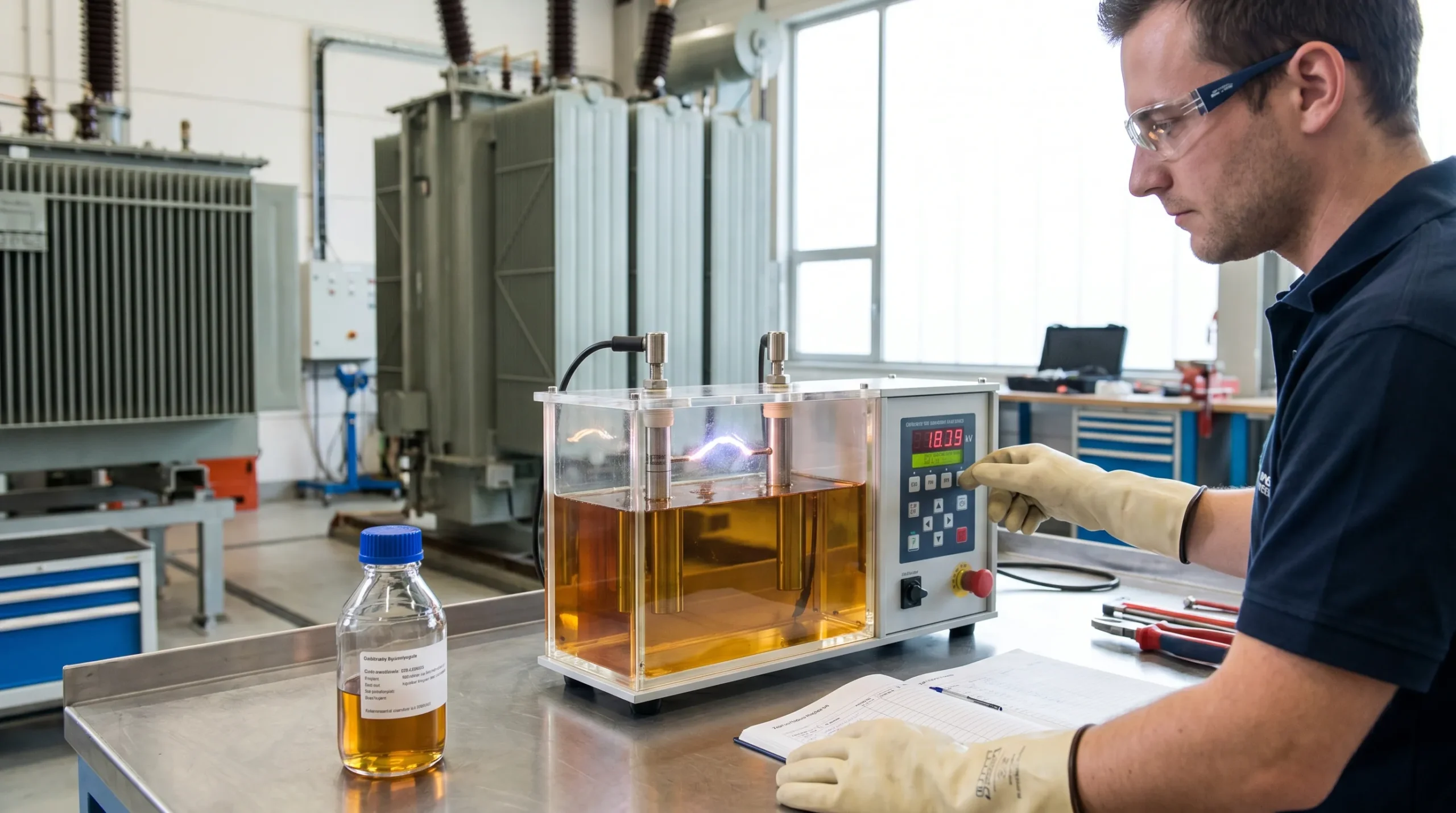
The standard process uses a BDV set with a test cell and standardized electrodes. A carefully collected oil sample is placed inside the cell, and voltage is increased at a controlled rate until breakdown occurs. The breakdown value is then recorded. Some competitor material describes a 2.5 mm electrode gap and a ramp rate around 1–2 kV per second or 2 kV/s, while GlobeCore’s page also describes preparation steps, waiting time, and repeated breakdown readings used for averaging.
A Typical Test Flow
| Step | What happens | Why it matters |
|---|---|---|
| Sample collection | Oil is drawn carefully into a clean container | Prevents false low readings from contamination |
| Test cell preparation | The oil is poured into the cell with fixed electrodes | Creates controlled test conditions |
| Settling period | Some procedures allow time for bubbles to escape, such as 20 minutes | Reduces distortion from air bubbles |
| Voltage rise | Voltage increases at a controlled rate | Measures insulating performance consistently |
| Breakdown event | The oil fails and the reading is captured | Gives the BDV value |
| Repeat testing | The test is repeated several times—some pages mention 6 breakdowns, 5 subsequent breakdowns, or 5–6 repetitions | Produces a more reliable average |
Some competitor descriptions also mention electrode sizes such as 8 mm diameter and 25 mm diameter, as well as intervals like 10 minute intervals between test events in certain procedures. Those details matter because acceptable BDV values depend on the exact test method used.
Why Multiple Tests Are Averaged
One of the smartest things the better pages explain is that the oil is not judged by one single flash event. Repeated testing helps remove randomness caused by bubbles, tiny particles, or sample instability. That is why average breakdown value is often more useful than a single reading.
What Is a Good or Acceptable BDV Value?
This is one of the most searched parts of the topic, but also one of the easiest to oversimplify.
Some competitor material uses 30 kV as a practical minimum benchmark, while other pages discuss higher insulation-strength figures such as 50 kV/mm or 750 kV/in in broader technical terms. The problem is that these values are not always presented under the same method or service condition. A reading that looks acceptable under one method may not translate cleanly to another.
So, instead of promising a single magic number, a trustworthy article should explain three things:
- Test method matters
- New oil and in-service oil should not always be judged the same way
- Trend over time often matters more than one isolated result
That is why phrases like acceptable BDV value for transformer oil, pass/fail criteria for transformer oil dielectric strength, and new oil vs in-service oil BDV values are so valuable as content additions. They answer the user’s real concern without pretending every transformer should follow one universal number.
Factors That Affect the Dielectric Strength of Transformer Oil
Several factors can change the dielectric strength of transformer oil, sometimes dramatically.
The most important factor is moisture. Even a small amount can weaken insulation performance. Next comes particle contamination, including dirt, fibers, and wear-related debris. Then comes thermal aging, where heat accelerates oxidation, forming acids, sludge, and other degradation products. Gas content, air bubbles, and poor sample handling can also lower the measured result.
Temperature also matters. Competitor content references performance-related figures like 50°C and low-temperature properties like -45°C, showing that transformer oil condition is not one-dimensional. Storage environment, relative air humidity, and equipment age all play a role as well.
A factor many competitors do not explain well enough is testing error. If the sample is collected badly, exposed to dirty containers, or shaken into bubbles, the result may reflect the sampling process more than the oil’s true condition. That is why effect of sample handling on BDV and common BDV testing mistakes are strong content gaps to cover.
How to Improve the Dielectric Strength of Transformer Oil
If transformer oil dielectric strength is low, the next question is obvious: How do you improve it?
The first option is often filtration, which removes suspended particles and some contamination. If moisture is the bigger issue, vacuum dehydration may be more effective because it targets water content directly. When aging compounds and degradation are more advanced, transformer oil regeneration may be needed to restore useful properties. If the oil is too degraded, replacement may be the better path. Competitor pages repeatedly mention filtration, dehydration, reconditioning, and replacement, though they do not always explain clearly when each option makes sense.
Here is a practical decision view:
| Condition | Likely issue | Possible action |
|---|---|---|
| Low BDV with visible contamination | Particles / dirt / fibers | Filtration |
| Low BDV with moisture suspicion | Water contamination | Vacuum dehydration |
| Low BDV with aging indicators | Oxidation / acids / sludge | Regeneration or deeper lab analysis |
| Repeated poor results plus aging | Severe deterioration | Replacement or major maintenance review |
This kind of decision support is exactly where your article can beat thinner competitor content.
Which Standard Should Be Used for the Test?
One of the biggest missed opportunities in competitor content is the lack of clear explanation around standards. Yet users benefit from knowing that BDV testing is method-dependent, and standards such as IEC 60156, ASTM D1816, and ASTM D877 are widely associated with insulating oil testing. Earlier live-search research also showed that these standards are strongly relevant to the current SERP around transformer oil dielectric strength.
A practical article should therefore explain that different standards use different conditions, including electrode design and procedure, which is why numbers should not be copied from one method to another without context. This is also why a value like 30 kV can sound acceptable in one source but incomplete in another.
Adding this standards section gives your article stronger technical authority and helps it serve readers who need more than a general explanation.
How to Interpret BDV Results Correctly
A BDV test is useful, but interpretation matters as much as measurement.
One reading does not define the whole oil condition story. It is much better to look at average breakdown value, repeated results, and historical trends. If the oil previously tested well and suddenly drops, that may indicate a recent contamination issue. If it declines gradually over time, the problem may be ongoing aging or moisture ingress. This is why single BDV reading vs trend monitoring is such a strong gap keyword. It reflects how real maintenance decisions are made.
It is also important to compare the result with the oil’s service status. New oil, in-service oil, and reconditioned oil may be judged differently. A result should be interpreted alongside operating history, sampling quality, and whether the transformer has other warning signs.
Why BDV Alone Is Not Enough
This is arguably the most important “expert” section of the whole article.
Breakdown voltage of transformer oil tells you whether the sample can resist breakdown under specific test conditions. It does not fully reveal why the oil changed, how severe chemical aging is, or whether internal transformer faults are present. That is why BDV alone is not enough for a complete transformer oil condition assessment.
A stronger maintenance program combines BDV with other tests such as:
- Karl Fischer moisture test
- Total Acid Number (TAN)
- Interfacial Tension (IFT)
- Dissolved Gas Analysis (DGA)
These tests help answer different questions. Moisture may be measured in ppm, acidity may be reported in mg KOH/g, and gas analysis can point toward internal electrical or thermal faults. Competitor pages hint at further lab testing, moisture, tan delta, and related checks, but they rarely build the full decision-quality picture.
Useful rule: BDV is an important screening test, but the best maintenance decisions come from BDV plus moisture, acidity, and other oil diagnostics.
Best Practices for Transformer Oil Sampling
A good test can still give a bad answer if the sample is poor.
That is why transformer oil sampling procedure deserves attention. The container must be clean, the sample must be handled carefully, and contamination from the environment should be minimized. Air bubbles, dirty glassware, wet sampling equipment, or delayed handling can all distort the result. Some procedures even allow a settling period before test to reduce bubble-related interference. Competitor content touches sample preparation, but not enough of them explain sampling as its own critical step.
For SEO and user value, this section is powerful because it answers a hidden pain point: sometimes the issue is not the oil itself, but how the oil was sampled.
How Often Should Transformer Oil Be Tested?
There is no single schedule that fits every transformer. Test frequency depends on the transformer’s age, service conditions, loading, environment, and maintenance history. However, the logic is simple: the more critical the asset and the more signs of deterioration it shows, the more important routine testing becomes. Competitor pages mention regular testing, predetermined intervals, and maintenance-driven monitoring, which supports including this section even though they do not develop it in enough detail.
This is where trend analysis of BDV results over time becomes more useful than one isolated number. A stable history is reassuring. A falling trend deserves action.
Practical Decision Guide: Filter, Regenerate, Retest, or Replace?
When the result is poor, many teams jump too quickly to replacement. A better approach is to ask four questions:
- Could the sample have been contaminated during handling?
- Is the problem mainly moisture or particles?
- Are there signs of chemical aging such as acidity or sludge?
- Do other oil tests confirm deeper deterioration?
If the issue appears to be sample quality, retest. If it is removable contamination, filter. If moisture is high, use dehydration. If the oil shows broader aging, consider regeneration. If multiple tests point to severe deterioration, replacement may be justified.
This decision-based explanation is exactly the kind of real-world value that helps an article stand out in search.
FAQ
What is the minimum dielectric strength of transformer oil?
Many sources mention 30 kV as a practical benchmark, but the right interpretation depends on the test method, oil condition, and service context.
What causes low BDV in transformer oil?
The most common causes are moisture, particles, air bubbles, oxidation, and other aging by-products.
Can filtration improve dielectric strength?
Yes. Filtration can improve results when suspended contaminants are the problem. Vacuum dehydration is often more helpful when moisture is the main issue.
Is low dielectric strength always a sign the oil must be replaced?
No. Some oils can be improved through filtration, dehydration, or regeneration. Replacement is usually considered when poor results are repeated and other indicators confirm deeper deterioration.
Why should BDV be checked along with moisture and acidity?
Because BDV alone is not enough. It shows breakdown performance, but moisture, TAN, IFT, and DGA help explain the oil’s overall condition and possible fault risks.
Conclusion
Dielectric strength of transformer oil is not just a technical phrase. It is one of the most practical indicators of whether the oil can still protect a transformer from electrical breakdown. Checking it helps detect moisture, contamination, and aging effects before they turn into serious reliability problems. But the smartest approach goes beyond one number. A good maintenance strategy combines BDV testing, correct sampling, result interpretation, and supporting diagnostics such as moisture testing, TAN, IFT, and DGA. When you understand not only how to test the oil, but also how to interpret the result, you make better decisions about whether to retest, filter, regenerate, or replace it. That is what really extends transformer life and reduces avoidable failures.