

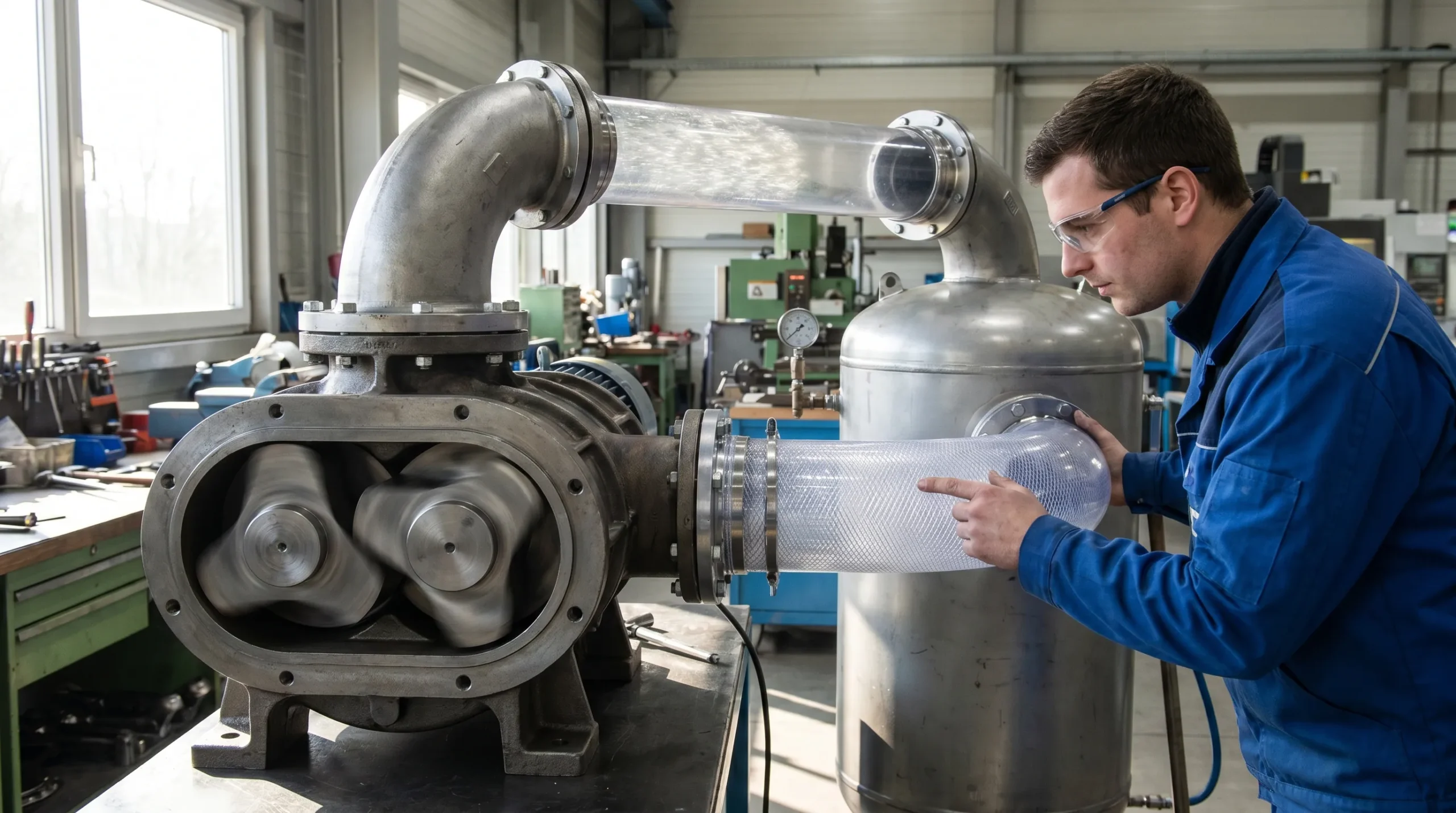
In roots blower the air is compressed by means of backflow from the receiver, or more precisely, by backflow from the discharge side into the compression chamber when the trapped air reaches the outlet. That is the direct exam-style answer, and it is the one most students are looking for when they search this exact phrase.
At first glance, this can feel confusing. A Roots blower clearly moves air, and it has rotors, meshing lobes, a housing, an intake side, and an outlet port, so many learners assume the machine must compress air internally in the same way a reciprocating compressor or rotary screw compressor does. But that is not how this machine works. A Roots blower is a positive displacement blower or positive displacement rotary lobe pump. It traps a volume of air and carries it from the inlet to the discharge side. The actual pressure rise happens when the trapped pocket opens to the high-pressure outlet, where counter-pressure and backflow from the receiver only create the compression effect.
That is why the standard explanation says a Roots blower works without internal compression. In many technical descriptions, it is also linked with external compression and sometimes discussed using isochoric compression language. For students, the easiest way to remember it is this: the lobes move the air, but the discharge-side pressure creates the compression.
What Is a Roots Blower?
A Roots blower is a positive displacement blower that uses two-lobed rotors, three-lobe rotors, or similar rotary lobes to transfer air from one side of the casing to the other. It is often called a rotary lobe blower, a Roots-type blower, or even a positive displacement lobe pump, depending on the application and the way the system is described.
The basic purpose of the machine is simple: it delivers a fixed volume of air. As the counter-rotating rotors spin, they trap air at the intake side and carry it around the casing to the exhaust side. Because of this fixed-volume movement, it belongs to the family of positive displacement machines.
This is also the reason a Roots blower is different from many other types of air compressor. A centrifugal compressor builds pressure through velocity and dynamic action. A reciprocating compressor compresses gas inside a cylinder with pistons. A rotary screw compressor uses meshing helical screws to reduce the gas volume internally. But a Roots blower mainly transfers the air first. The compression is associated with the outlet condition and pressure side, not with a strong internal squeezing action.
For exam preparation, that distinction matters a lot. If you remember only one point, remember this: a Roots blower is a positive displacement machine that transfers air in fixed pockets, while pressure rise mainly occurs because of discharge-side backflow.
How Does a Roots Blower Work Step by Step?
To understand how compression takes place in a Roots blower, it helps to follow the process in sequence.
First, air enters the machine through the intake side. The rotating lobes create expanding spaces near the inlet, and atmospheric air fills those spaces. The timed rotation of rotors is controlled by timing gears or a gear train, often maintaining a precise 1:1 gear ratio so the lobes do not touch each other.
Second, a fixed volume of air becomes trapped between the lobe surface, the housing, and the casing wall. This trapped air is then carried around the inside of the blower. At this point, the air is being moved, but it is not yet being heavily compressed inside the machine. This is why many sources describe the unit as operating with no internal compression or without internal compression.
Third, the trapped air reaches the outlet port or discharge opening. Now the important event happens. The discharge side already contains air at a higher pressure, often because of the connected receiver, piping, or downstream resistance. As soon as the trapped pocket opens to that side, compressed air flows back into the housing from the pressure side. This backflow from the receiver rapidly equalizes pressure and creates the compression effect people associate with the machine.
Fourth, the blower continues to push air out, and the cycle repeats continuously. Because the machine keeps delivering air in repeating pockets, it is excellent for low pressure air flow, high volume air movement, pneumatic conveying systems, and vacuum applications.
A simple way to explain the cycle is this: air enters, gets trapped, gets carried, meets the high-pressure side, and then experiences compression due to backflow. That is the heart of the Roots blower working principle.
Why the Air Is Compressed by Backflow from the Receiver
The phrase “in roots blower the air is compressed by means of backflow from receiver only” sounds mechanical and textbook-heavy, but the idea is actually straightforward.
Imagine that the blower has carried a packet of air from the inlet to the outlet. That air packet is now sitting in the compression chamber near the outlet port. On the other side of the outlet, the system already has a higher delivery pressure or discharge pressure. As soon as the chamber opens to the discharge side, some of that higher-pressure air rushes backward into the pocket. That reverse flow is the backflow from the receiver.
This does two things. First, it raises the pressure of the trapped air very quickly. Second, it creates the characteristic pressure equalization that makes the blower useful in real systems. The rotors are still essential because they keep moving the air into position, but the actual pressure increase is linked to the system pressure at the outlet.
That is why answers like plunger, squeezing action, or internal rotor compression are wrong in most exam settings. A Roots blower does not work like a reciprocating compressor with piston compression. It also does not reduce the gas volume the way a rotary screw compressor does. Instead, the machine depends on external compression principle and receiver backflow.
For a student-friendly short answer, you can write:
In a Roots blower, air is compressed by means of backflow from the receiver or discharge side, not by internal compression within the blower casing.
That one sentence is often enough for an engineering exam. But for deeper understanding, remember the process behind it.
Internal Compression vs External Compression in a Roots Blower
A major source of confusion is the difference between internal compression and external compression.
Internal compression means the gas pressure rises mainly inside the machine because the machine reduces the gas volume directly. This happens in devices like a reciprocating compressor or rotary screw compressor. The machine itself performs the compressing action in a strong mechanical way.
A Roots blower, however, is usually described as a machine with external compression. The blower transports the air internally, but the main pressure rise appears when the trapped air meets the already pressurized discharge side. That is why many technical explanations say the machine operates without internal compression.
You may also see the term isochoric compression in discussions of the Roots blower external compression principle. In simple words, this refers to a pressure rise that happens very quickly when the chamber opens to the higher-pressure side, rather than from a gradual volume reduction inside the blower. For many students, the exact thermodynamic wording is less important than the practical takeaway: the blower moves air first and pressure equalization happens at the outlet.
This distinction explains several real-world characteristics of the machine. It helps explain why Roots blowers are usually preferred for very low pressure applications, why they can have high noise level, and why they may show low efficiency compared with some other compressor types when higher pressure ratios are needed.
Simple Diagram-Style Explanation of the Cycle
Even without a picture, a stage-by-stage explanation can make the process clear.
| Stage | What happens | Key idea |
|---|---|---|
| Stage 1 | Air enters through the inlet as the lobes rotate | Intake side fills with atmospheric air |
| Stage 2 | A pocket of air becomes trapped between the pair of meshing lobes and the casing | Fixed volume is carried forward |
| Stage 3 | The trapped air moves around the casing toward the outlet port | Air transport, not strong internal compression |
| Stage 4 | The air pocket opens to the high-pressure discharge side and backflow from receiver only raises pressure | Compression by discharge-side backflow |
This style of explanation works very well for searchers who want a Roots blower diagram explanation or a step-by-step working of Roots blower. It also helps students understand why the machine is called a positive displacement blower. The lobes do not need to touch the air like pistons in a cylinder. They simply trap and move a volume through the casing.
Some designs use two identical counter-rotating rotors, while others use three-lobe rotors. A third lobe can help reduce pulsation and vibration compared with basic two-lobed rotors. Regardless of whether the design uses two-lobed rotors, three-lobe rotors, or even specialized rotor profiles, the core principle remains the same.
Why a Roots Blower Is Called a Positive Displacement Machine
The term positive displacement means the machine moves a nearly fixed amount of air per revolution. That fixed volume is created by geometry: the lobe shape, the casing, the clearance between the lobes, and the timing of rotation.
This is different from dynamic machines like a centrifugal compressor or axial compressor, where energy is added to the fluid mainly through speed and flow dynamics. In a Roots blower, the air is physically trapped and carried along.
That is why related phrases such as positive displacement lobe pump, rotary lobe pump, and displacement compressor appear so often in technical writing. They all point back to the same core idea: the machine displaces air volume directly.
The concept also explains why Roots blowers are so useful when a process needs reliable air delivery rather than very high pressure. In systems such as pneumatic conveying, the machine’s ability to move steady volumes of air is often more important than achieving a high compression ratio.
Roots Blower vs Compressor: What Is the Real Difference?
Many learners ask roots blower vs compressor because the line between the two can seem blurry. The simplest answer is that a Roots blower is technically a kind of positive displacement air-moving machine, but in practical use it is usually treated separately from higher-pressure compressor systems.
Here is a simple comparison:
| Machine | How pressure is created | Best known for |
|---|---|---|
| Roots blower | Pressure rises mainly by backflow from the pressure side | Low pressure, high volume air movement |
| Reciprocating compressor | Pistons compress gas inside a cylinder | High-pressure compression |
| Rotary screw compressor | Meshing helical screws reduce gas volume | Efficient continuous compressed air |
| Centrifugal compressor | Dynamic action through impeller and diffuser | Large flow in dynamic systems |
So when someone asks what is the difference between a roots blower and a compressor, the best answer is this: a Roots blower mainly moves air and develops pressure through outlet-side conditions, while many conventional compressors create pressure through stronger internal compression mechanisms.
That is also why the search phrase is a Roots blower a compressor or a blower keeps appearing. In classroom language, it is safer to call it a blower unless the question specifically focuses on the wider category of positive displacement compression equipment.
Advantages and Limitations of a Roots Blower
A Roots blower has several practical strengths. It has a relatively simple design, often provides oil-free air delivery in the air path, and can give steady airflow for industrial systems. It is especially valuable in low pressure applications where a large volume of air is needed continuously.
But it also has limitations. Because the pressure rise depends on outlet conditions and rapid equalization, the machine can have high noise level and low efficiency compared with other systems under higher-pressure demands. Pulsation can also become an issue, especially in simpler designs. This is one reason why engineers look at design choices such as three-lobe rotors, improved casing geometry, and better silencing methods.
A short practical case example is wastewater aeration. In that setting, the process often values steady airflow, rugged operation, and dependable low-pressure performance. A Roots blower can be a good fit there. But if the plant needs much higher pressure with better energy efficiency, another compressor type may be preferable.
So the machine is not “bad” or “outdated.” It is simply best when matched to the right job.
Common Applications of Roots Blowers
The most common Roots blower applications involve moving large volumes of air at relatively low pressure. This includes pneumatic conveying systems, vacuum pump support roles, wastewater treatment aeration, industrial applications, and some specialized commercial applications.
In pneumatic conveying, the blower helps move bulk solids by maintaining airflow through piping. In aeration systems, it supplies air to tanks where oxygen transfer matters. In some vacuum applications, the machine can also support low-vacuum duties.
Historically, Roots-type blowers have also appeared in supercharger use, two-stroke diesel engines, four-stroke engines, and even specialized automotive contexts. Famous related terms such as 4–71 blowers, 6–71 blowers, and 71 series diesels appear in historical and performance discussions. In automotive language, some systems become especially effective around 2000 rpm, though those performance details belong more to engine-supercharger discussions than to the exact exam keyword here.
For topical authority, it helps to mention both industrial and historical use cases, but the main focus should remain on the working principle and exam answer.
Common MCQs and Exam Mistakes About Roots Blowers
Students often lose marks on mechanical engineering MCQ questions because the wording is tricky. Here are a few examples.
Q1. In roots blower the air is compressed by means of.
Correct answer: backflow from receiver only
Q2. Does a Roots blower have internal compression?
Correct answer: No, it is generally described as working without internal compression
Q3. Roots blower is an example of what type of machine?
Correct answer: positive displacement blower
Q4. Which compressor type uses pistons and cylinder action?
Correct answer: reciprocating compressor
Common wrong options include plunger, squeezing action, vague references to “rotor pressure,” or confusion with vane compressor operation. The best strategy is to focus on the process: transport first, pressure equalization at the outlet second.
One easy memory trick is this:
Roots blower = lobes move air; receiver backflow raises pressure.
That single line can save you from several common exam mistakes.
P-V Diagram and Simple Thermodynamic Interpretation
A beginner-friendly P-V diagram of Roots blower does not need a complex derivation. The important point is that the trapped air volume is carried forward more or less as a fixed pocket, and then the pressure rises sharply when the chamber opens to the high-pressure discharge side.
That is why discussions of thermodynamic cycle, ideal gas law, and isochoric compression sometimes appear in more technical explanations. In simple terms, the pressure rise is linked to the sudden communication between the chamber and the discharge region, not to a long internal squeezing process.
This also helps explain why the machine may not be the best choice when high compression efficiency is required. Since the system depends on discharge-side equalization, the process can generate losses, noise, and pulsation under some operating conditions.
For most students, the best practical takeaway is this: the P-V behavior supports the idea that compression is associated with outlet opening and backflow, not classic internal volume reduction.
Maintenance and Troubleshooting Basics
Although the main keyword is educational, adding a short maintenance section strengthens topical authority. Common concerns include bearings, labyrinth seals, timing gears, overheating, unusual noise, and air leakage.
If the blower becomes excessively noisy, the issue may involve alignment, pulsation, or worn rotating components. If airflow drops, engineers may check clearances, leakage, or downstream resistance. If operating temperature rises, the problem may relate to discharge temperatures, poor lubrication in protected areas, or improper system loading.
This kind of section helps the article serve both students and beginners in industry. It shows not just what the machine is, but how it behaves in real life.
FAQs About Roots Blower Compression
In Roots blower the air is compressed by means of what?
It is compressed by backflow from the receiver or backflow from the discharge side.
Does a Roots blower compress air internally?
In standard engineering explanation, no. It is usually described as working without internal compression.
Why is it called external compression?
Because the pressure rise mainly happens when the trapped air pocket opens to the higher-pressure discharge side.
Is a Roots blower a compressor or a blower?
In most practical and exam contexts, it is treated as a blower, though it belongs to the broader family of positive displacement air-moving equipment.
Where are Roots blowers used?
They are used in pneumatic conveying, aeration, vacuum applications, and other low pressure air flow systems.
Why are Roots blowers noisy?
Rapid pressure equalization, pulsation, and outlet-side conditions can contribute to high noise level.
Final Answer Summary
The best answer to “in roots blower the air is compressed by means of” is backflow from receiver only. A Roots blower is a positive displacement blower that traps and transports air with meshing lobes and counter-rotating rotors. However, it does not rely on strong internal compression. Instead, when the trapped air pocket reaches the outlet port, higher-pressure air from the pressure side flows back into the chamber and raises the pressure. That is why the technically correct explanation is based on external compression and receiver backflow, not piston-like squeezing inside the casing.
Disclaimer: This article is for educational purposes only. Technical explanations may differ slightly across textbooks and standards. Always consult your syllabus, instructor, or official engineering references for accurate definitions, formulas, and exam-related answers or professional applications.