

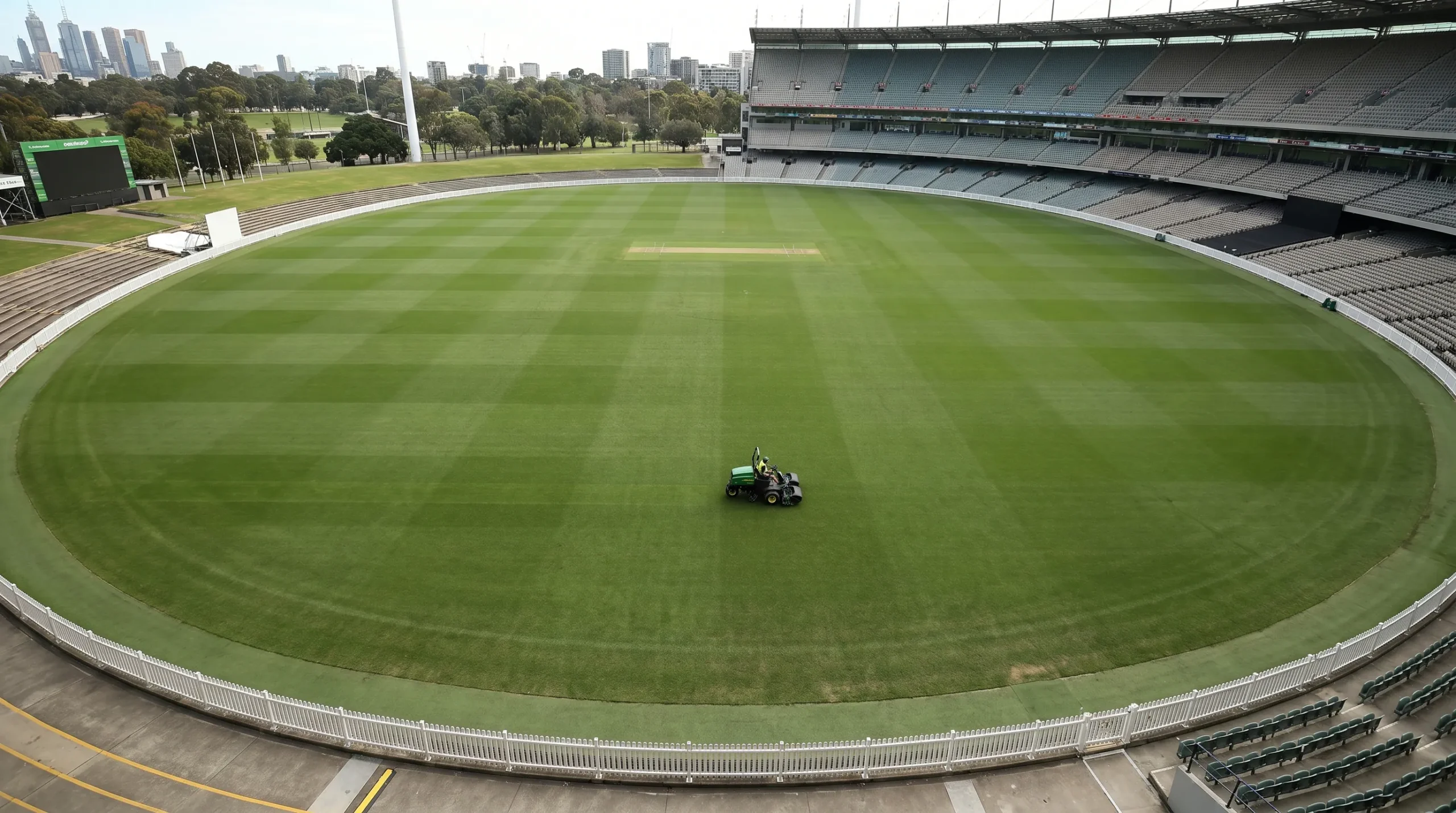
Biggest cricket stadium in the world by boundary is a query that sounds simple, but it often gets mixed up with a completely different question: which cricket stadium is the biggest by seating capacity. In most boundary-based comparisons, the Melbourne Cricket Ground (MCG) is treated as the leading answer because of its huge playing area and long straight and square boundaries, while Narendra Modi Stadium is the world’s biggest cricket stadium by capacity, not necessarily by boundary size. The MCG’s commonly cited cricket dimensions are about 172.9 m x 147.8 m, while Narendra Modi Stadium is often listed around 180 yd x 150 yd and has a capacity of roughly 132,000.
That distinction matters because many articles lump together boundary length, ground dimensions, playing surface, and crowd capacity as if they all mean the same thing. They do not. A stadium can hold the most people and still not be the ground most people mean when they ask for the biggest cricket ground by boundary. To answer the search intent properly, you need to look at field dimensions, boundary setup, and the ICC’s rules on how far the rope can be from the center of the pitch.
Which Is the Biggest Cricket Stadium in the World by Boundary?
If the question is which cricket ground is the biggest by boundary, the answer most commonly given is the Melbourne Cricket Ground (MCG). That is because the MCG is famous for its vast oval shape and large cricket field, and multiple cricket-focused rankings place it at or near the top when discussing the largest cricket grounds in the world by boundary length. Cricket-focused comparison pages also repeatedly use the MCG as the reference point for boundary size, playing area, and the challenge it creates for batters trying to clear the rope.
The confusion begins when people compare the MCG to Narendra Modi Stadium in Ahmedabad. Narendra Modi Stadium is officially recognized as the largest cricket stadium in the world by capacity, at around 132,000 seats. That makes it the biggest answer for crowd size, but not automatically the biggest answer for largest cricket ground by boundary. In search behavior, users often want a single answer, but the truth is that the right answer changes depending on whether you mean boundary / playing area or spectator capacity.
So, in simple terms:
| Question | Most common answer |
|---|---|
| Biggest cricket stadium in the world by boundary | Melbourne Cricket Ground (MCG) |
| Biggest cricket stadium in the world by capacity | Narendra Modi Stadium |
That single clarification already makes the topic much more useful than many ranking articles on the web.
Biggest by Boundary vs Biggest by Capacity: Do Not Confuse the Two
A lot of users type biggest cricket stadium in the world by boundary but are really caught between two different searches. One is about the largest playing surface. The other is about how many people a stadium can hold. Competitor pages often blend those two angles because “biggest” attracts more clicks, but for readers it creates confusion.
The Narendra Modi Stadium in Ahmedabad is the easiest example of this confusion. It has a listed capacity of about 132,000, which makes it the world leader by crowd size. The MCG, meanwhile, is usually cited at just over 100,000 capacity, but it remains the more common answer when people discuss the biggest cricket ground by playing area or longest boundaries.
This is why a good article should not just repeat “largest cricket stadium” without context. It should explain the difference between:
- stadium capacity
- ground dimensions
- straight boundary
- square boundary
- actual rope placement for a specific match
Those details matter because a ground’s physical size may be huge, but the boundary rope can still be brought inward on match day. That means the same venue can appear bigger or smaller depending on format, event setup, and measurement method.
How Cricket Boundary Size Is Measured
To understand the biggest cricket stadium in the world by boundary, you have to know how cricket grounds are measured. Cricket venues are not all identical, and unlike many sports, cricket grounds can vary widely in shape. Some are close to round, others are clearly oval, and many use different straight and square boundary lengths.
When articles talk about boundary size, they usually refer to the distance from the center of the pitch to the rope in different directions. That is why you often see pairs of numbers, such as one value for the straight boundary and another for the square boundary. This is also why fans often ask why cricket boundaries are “not even.” On an oval ground, the shape itself creates different distances in different directions. The MCG, for example, is famous for its wide playing area and oval layout, which is one reason it is repeatedly cited in “largest ground” discussions.
Another reason rankings differ is that some writers focus on a venue’s overall field dimensions, while others focus on the active boundary rope used during a specific match. If one list uses the full playing oval and another uses a match-day rope placement, the numbers can look different even when they describe the same stadium. That is exactly why readers need a section that explains how to measure a cricket boundary instead of just throwing out a top-10 list.
ICC Boundary Rules: Minimum and Maximum Limits
This is the section most competitor articles underuse, even though it is one of the most important for search intent.
Under the ICC Men’s T20I playing conditions, boundaries should be no shorter than 65 yards (59.43 m) and no longer than 90 yards (82.29 m) from the center of the pitch. The ICC also states that the size of the playing area should be maximized wherever possible. In practical terms, that means there is an official framework for what counts as an acceptable boundary in top-level international cricket.
That rule helps explain why the question how big can boundaries be in international cricket has a more nuanced answer than many blog posts suggest. A stadium may be physically enormous, but the rope used for an international match is still expected to fit within the ICC’s permitted range. So when people ask for the biggest cricket ground by official dimensions, what they often really need is a mix of two answers: the ground’s overall field size and the actual playing boundary used in international matches.
This is also why the phrase “largest cricket stadium by boundary” should not be treated as a pure architecture question. It is partly a rules question, partly a measurement question, and partly a venue-comparison question.
Top 10 Biggest Cricket Stadiums in the World by Boundary
Below is a practical comparison table based on the recurring stadiums and dimension pairs found across competitor content. Rankings can vary slightly by source because not all pages use the same measurement method, and some rely on straight / square boundary pairs while others emphasize the total playing oval. Still, these names appear again and again in boundary-based cricket rankings.
| Rank | Ground | Commonly cited boundary/dimension data | Country |
|---|---|---|---|
| 1 | Melbourne Cricket Ground (MCG) | 83.43 m / 86.24 m or large overall oval dimensions | Australia |
| 2 | Sydney Cricket Ground (SCG) | 93.72 m / 72.83 m | Australia |
| 3 | Singhalese Sports Club Cricket Ground | 86.10 m / 77.02 m | Sri Lanka |
| 4 | Hagley Oval | 83.58 m / 77.46 m | New Zealand |
| 5 | Basin Reserve | 81.70 m / 72.48 m | New Zealand |
| 6 | Lord’s Cricket Ground | 88.87 m / 65.21 m | England |
| 7 | Imperial Wanderers Stadium | 86.76 m / 64.14 m | South Africa |
| 8 | Kensington Oval | mid-70 m range in some comparisons | Barbados |
| 9 | Narendra Modi Stadium | often cited around 180 yd x 150 yd | India |
| 10 | Eden Park / Eden Gardens | frequently included depending on source method | New Zealand / India |
1. Melbourne Cricket Ground (MCG)
The MCG is the most widely accepted answer when someone asks for the biggest cricket stadium in the world by boundary. It is one of the most iconic venues in world cricket and is also used for major Australian sporting events beyond cricket. Its enormous oval makes it harder to clear the rope cleanly, and that has shaped the way players and fans think about the ground for decades. The MCG is also central to events like the Boxing Day Test, which adds to its global recognition.
2. Sydney Cricket Ground (SCG)
The SCG is another giant venue commonly included in large-boundary rankings. Its dimensions differ sharply between straight and square sides, which is a good example of why cricket grounds are rarely symmetrical. For SEO purposes, it is a strong supporting LSI keyword because users often search multiple famous Australian venues together.
3–8. SSC, Hagley Oval, Basin Reserve, Lord’s, Imperial Wanderers, Kensington Oval
These grounds show how global the topic is. Sri Lanka, New Zealand, England, South Africa, and the Caribbean all appear in the competitor rankings. That helps broaden topical authority because the keyword is not only about one famous venue. It is also about understanding which countries regularly host cricket on large playing surfaces and how venue shape affects boundary length.
9. Narendra Modi Stadium
This is where many readers get surprised. Narendra Modi Stadium is a massive venue and the world leader by capacity, but in boundary-specific discussions it is usually not treated as the single clearest number-one answer in the way the MCG is. That does not make it small. It simply means biggest by boundary and largest by seats are different categories.
MCG vs Narendra Modi Stadium: Which One Is Actually Bigger?
This is the most important comparison for modern readers.
If you ask, which is bigger MCG or Narendra Modi Stadium, the answer depends on what “bigger” means. If you mean crowd capacity, the answer is Narendra Modi Stadium, with about 132,000 seats. If you mean the venue most often described as the biggest cricket ground by boundary / playing area, the answer is still usually the MCG.
That is why articles that chase clicks with broad titles often leave users unsatisfied. A better explanation is this:
| Metric | MCG | Narendra Modi Stadium |
|---|---|---|
| Most cited for biggest by boundary / playing area | Yes | Sometimes discussed, but less often the top answer |
| Largest by seating capacity | No | Yes |
| Most famous boundary comparison keyword | MCG boundary size | Narendra Modi Stadium dimensions |
This comparison alone gives your article an edge because it answers the real user problem, not just the headline query.
Why Boundary Size Changes from Match to Match
One reason this topic is tricky is that cricket boundaries are not permanently fixed in one universal way. On some grounds, especially for shorter formats, ropes can be moved inward. The ICC rules set a range, but venue setup, event logistics, and even safety or broadcasting considerations can affect the final match-day boundary.
That means a stadium known for large dimensions can still host a match with a shorter effective boundary than fans expect. This is especially relevant when people search does boundary size change in T20 and ODI matches. The answer is yes, it can. The ground itself remains the same, but the field of play can be adjusted within the rules. That is one more reason why articles ranking the biggest cricket stadiums by boundary size should explain why boundary ropes move inward instead of pretending every match uses the full outer edge of the stadium.
How Large Boundaries Affect Batting, Bowling, and Match Strategy
Large boundaries have a real effect on the game. On a massive ground like the MCG, mishits that might clear the rope elsewhere can drop short. That changes batting intent, rewards smarter placement, and often places more value on running between wickets. Big boundaries can also help bowlers by turning would-be sixes into catches near the rope or long twos and threes inside it. This tactical angle appears in some competitor pages, but it is rarely developed properly.
For fielding sides, large venues reward athletic fielders, good relay throws, and sharp outfield coverage. For batters, they demand power plus precision. For captains, boundary size can change where they station fielders and how aggressively they attack with spin or pace. So when users ask how does boundary size affect sixes in cricket, the real answer is that larger grounds change the rhythm of the innings, not just the scorecard.
A simple case-study way to frame it is this: on a ground with huge square boundaries, cross-batted shots may not travel as well as they do at a smaller venue. That can reshape both batting plans and bowling matchups.
Biggest Cricket Grounds by Boundary in Different Countries
Another useful angle competitors mostly ignore is the country-by-country view.
In Australia, the conversation almost always starts with the MCG and the SCG. In India, the focus shifts quickly to Narendra Modi Stadium and Eden Gardens. In New Zealand, venues like Hagley Oval, Basin Reserve, and Eden Park often appear in discussions about cricket ground dimensions. In Sri Lanka, the Singhalese Sports Club is a recurring name, while Lord’s remains the classic English benchmark. Imperial Wanderers Stadium in South Africa and Sheikh Zayed Stadium in the UAE also show up in comparison-style stadium content.
This regional angle helps because some users are not only searching for the single biggest answer. They also want related information like the largest cricket stadiums in India, the biggest grounds in Australia, or the largest cricket venues in Asia.
FAQs About the Biggest Cricket Stadium in the World by Boundary
Is MCG the biggest cricket stadium in the world by boundary?
In most cricket-focused comparisons, yes. The Melbourne Cricket Ground is the venue most commonly presented as the biggest answer when the question is specifically about boundary size or playing area.
Which stadium is biggest by capacity?
That is Narendra Modi Stadium in Ahmedabad, with a listed capacity of around 132,000.
What is the ICC rule for boundary size?
For men’s T20 internationals, boundaries should be at least 65 yards (59.43 m) and at most 90 yards (82.29 m) from the center of the pitch, and the playing area should be maximized as much as possible.
Can boundary size change in T20 matches?
Yes. The boundary rope can be brought inward depending on match setup, as long as the ground still fits within the competition rules.
Why do websites rank cricket grounds differently?
Because they often use different methods. One site may rank by overall field dimensions, another by straight and square boundary pairs, and another by match-day rope placement. That is why lists can vary without necessarily being wrong.
Final Words
If your goal is to answer the keyword biggest cricket stadium in the world by boundary as clearly as possible, the strongest answer is the Melbourne Cricket Ground (MCG). If the question changes to biggest cricket stadium by seating capacity, then the answer becomes Narendra Modi Stadium.
That distinction is the key to satisfying search intent. The best article on this topic should not just rank famous venues. It should explain boundary size, playing area, ICC rules, match-day rope placement, and the difference between capacity and ground dimensions. Once you make that clear, the topic stops being confusing and becomes genuinely useful.
Disclaimer:
This article is provided for general informational purposes only. It explains cricket stadiums by boundary size, playing area, and capacity. Individual interpretations or experiences may vary, so readers should verify details independently.
 admre88mb